Long Beach in tie-up with inland port and rail operator to move boxes faster

The Port of Long Beach has made a deal with a Utah site to transfer containers there, to relieve the congestion at the Long Beach terminal yards.

Moving containers by rail to Utah will clear space at the port and allow faster unloading there. The containers can then be picked up in Utah and forwarded to the points in the US.

This is a good strategy for the port. Many European ports, such as Rotterdam, Hamburg, and Antwerp, have done the same thing. In Europe, the containers tend to be moved by river barge or truck, but in the US, rail is the natural transportation mode to use.

It’s an idea that has been suggested years ago for the large ports on the West Coast US, but it took a crisis for it to happen.

I thought that long ago the ports would make such agreements with the Centerpoint complex in the Chicago area. Much of the container cargo moves to the Chicago area, for distribution to the rest of the United States. 8 years ago, Centerpoint had empty space available. Now it is completely built out, according to my informants.

Below the articles, I’ve provided my reference to our article of 2014, which suggested forging alliances with the Chicago warehouses.

By Ian Putzger in Toronto 28/10/2021

Long Beach in tie-up with inland port and rail operator to move boxes faster  – The Loadstar
Published Oct. 28, 2021
Sarah Zimmerman

Union Pacific steps up efforts to ease West Coast port congestion

Our paper of 2014:

Clott, Christopher B. and Bruce C. Hartman. (2014). “Supply Chain Integration, Landside Operations and Port Accessibility in Metropolitan Chicago”.  Journal of Transportation Geography (51) 131-139. DOI: 10.1016/j.jtrangeo.2015.12.005
Trucking key issues in 2021

One of my favorite sources for information about trucking and truck drivers is ATRI, the American Transportation Research Institute. It’s a nonprofit with board members from every aspect of the trucking industry.

Each year they publish a report on the top industry issues for the year. It’s based on surveys. You can get it here. https://truckingresearch.org/atri-research/top-industry-issues/

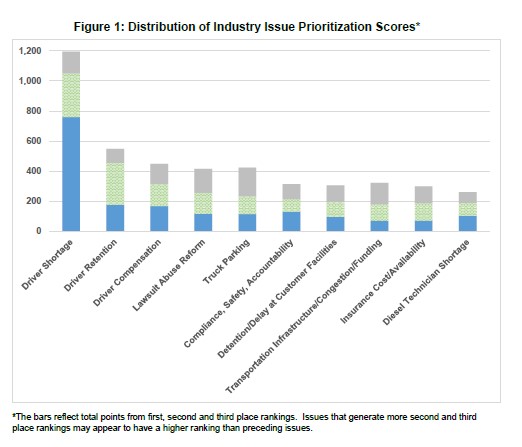
It is always interesting reading. This year issues related to driver retention rose to the top of the list. We can see that at a glance by inspecting Figure 1, from page 4 of the report. The top 3 deal with the driver crisis in trucking.

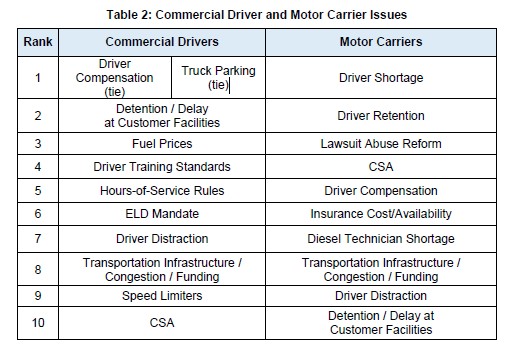
One of the most interesting aspects of the report is a comparison between the attitudes of commercial drivers and those of motor carriers. The two groups have very different concerns, which are telling. The gap in concerns may represent why drivers are leaving the trucking workforce. I’m including Table 2 from the report below, which clearly portrays those different views.

Drivers are very concerned about compensation, truck parking, and delays at customer facilities, all of which affect their bottom line directly. Motor Carriers are concerned about the driver shortage and retention; I have heard that about 90% of drivers leave their current job within the first two years.

It seems to me that motor carriers ought to think about how they might have an impact on the truck parking problem nationally, and the detention or delay problems. Those factors are influencing drivers to choose to leave the profession or to switch to a company that can offer something that improves those dimensions. Money isn’t the whole story, though there is certainly a need for truck driver compensation to improve; both sides understand that.

One important dimension of trucking that cannot be overlooked in the US is the division between Owner-Operators and Company Drivers. There are different factors at work for these two very different classes of drivers. The ATRI Survey brings that out clearly in Table 3 of the report.

Both groups rate Truck Parking high, because it affects scheduling breaks and their ability to earn by moving goods. A search for a parking spot is time not spent transporting the goods.

But as one would expect, Owner-Operators are concerned about fuel prices, because they pay that themselves out of their piece-work fee for carrying the load. Company drivers do not have to pay for fuel themselves; it’s a company expense, and not money directly out of their pocket.

Compensation, whether by wages or by per-load fees, is a major issue for both groups.

I want to give a shout-out to ATRI for their diligence in producing this study each year. It’s a valuable resource for understanding the state of the trucking industry and gives us info that can drive our thinking about how its individual participants need to change.

New fees for lingering containers at LA/Long Beach Ports

To get the attention of shippers and carriers, the Port of Long Beach and the Port of Los Angeles have instituted escalating fees for containers that are not picked up at the port. The fines start at $100 per day and go up with each following day.

These fees have been endorsed by the US Supply Chain Disruptions Task Force.

There are lots of efforts to try to give ocean carriers and shippers incentives to move cargo out. Railroads UP and BNSF also are planning to offer rebates to shippers who move cargo to them on weekends, using the longer time windows at the ports. The large rails are also taking other steps to improve flow. UP is reopening an idled rail terminal in the Chicago area, near the Centerpoint logistics complex. The refunds apply to containers in-gated at the ICTF (Intermodal Container Transfer Facility) in Long Beach CA. BNSF’s rebates apply both to LA and Long Beach.

We’ve also heard about California Governor Gavin Newsom’s efforts to find space to store containers, by leasing empty land near key transfer points.

Naturally, there are complaints about fees, which will surely be passed on to consumers. And many point to the general logjams for containers at warehouses and other choke points in supply chains. Dispersed bottlenecks are harder to do anything direct about; perhaps a money impact is the best way to get these diverse players to work harder to relieve the jam-ups.

And there’s a bit of contradiction, with the FMC looking into excessive demurrage and detention fees at port terminals, a long-standing gripe of shippers, while watching two ports add to those burdens.

Yet, there is some action. So the complaining is good, and a variety of approaches makes it more likely that the logjam will start to abate as more folks speed things up all over.

Read the articles for more details and different views.

Eric Kulisch, Air Cargo Editor Wednesday, October 27, 2021

Joanna Marsh Tuesday, October 26, 2021