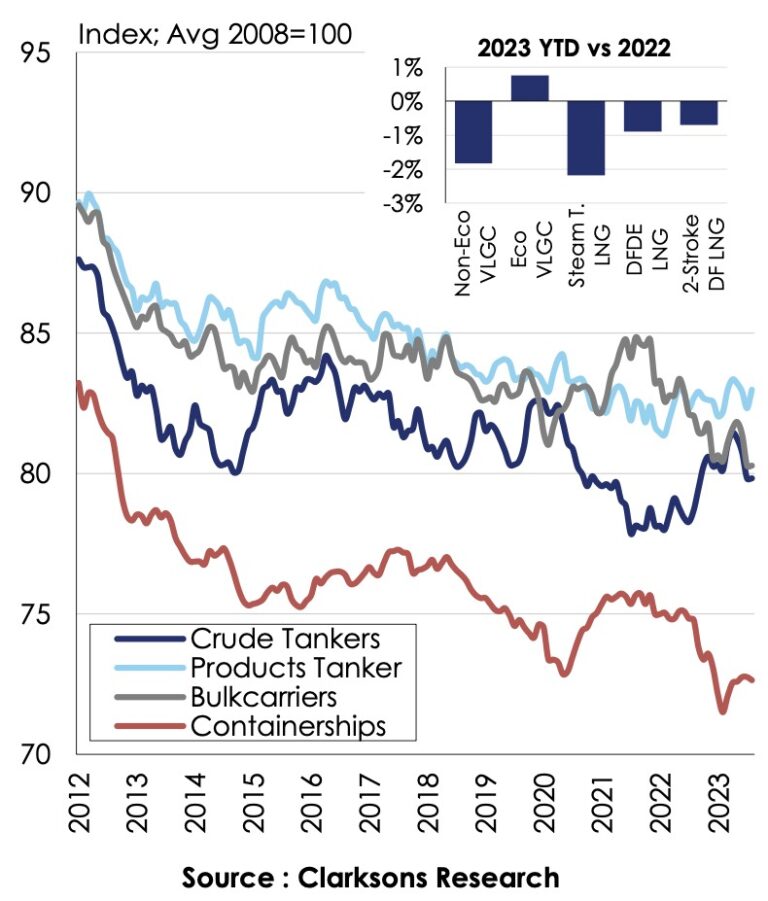
Slow steaming is a good way to save on fuel costs and meet the new IMO requirements. So ships have slowed down. But I was amazed at the graph below, showing a trend for quite a while.
Slowing down is an important way of cutting CO2 emissions from fuel oil. It also implies that more ships are needed to meet planned sailings on a scheduled route. It’s a deliberate reduction of individual ship ‘productivity’, since fewer paid cargo-carrying trips can be made in a year. But it may be a better fit with the demand for shipments right now, and it might result in fuller vessels.
We should remember that slow steaming will not eliminate CO2 emissions problems; it’s a stopgap at best. New types of power with very low or zero emissions through their life cycle well-to-wake must be developed. The investments have to be made.
There is a shortage of ro-ro (roll on roll off) capacity for moving vehicles by sea. One possibility to move the cars is to put them into containers and ship them on container ships. But you can only get so many into a container – two per (twenty-foot equivalent unit) TEU or four in a forty-foot container.
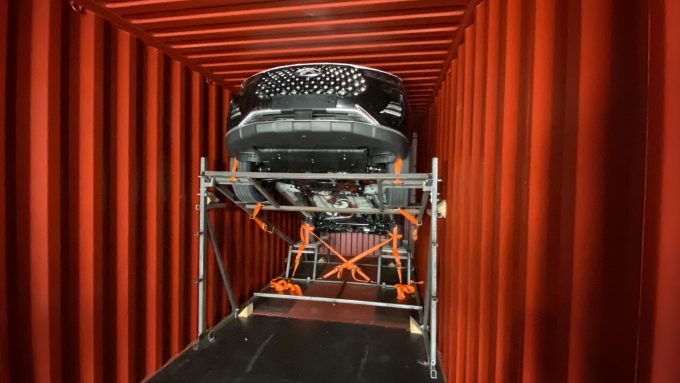
One solution would be to find a way to pack them tighter. And that’s what DP World, the large port operator, has done for voyages from China to Turkey. They can now get three Chery vehicles in a container.
Chery Automotive is a major Chinese car manufacturer, with a portfolio of ICE, hybrid, and all-electric vehicles. In July, they imported 10,000 SUVs into Turkey from China using this method.
Turkey is a big market for Chinese cars, but it’s also a gateway to Europe. Cars brought to Turkey could be sold on into European countries.
Packing of containers has always been a way to avoid shipping ‘air’ (empty space). But one issue is the incidence of fires on ships from lithium battery explosions. These explosions have become quite frequent. It’s due to the heat and close packing. So far, ro-ro ships have suffered most, though there have been lithium battery fires on container ships, due to shipments of other battery-powered equipment. Adding large numbers of cars will make the risk greater.
A TT Club risk management director noted that automakers are simply trying to get more energy into batteries, not investing in how to reduce the danger from shipment. They need to focus more on the risk in their designs.
Here’s a picture of the stacking. It’s not very clear, but you can see the rack.
We all know now that the Panama Canal is suffering from a lack of water, due to a prolonged drought. The result is limits on draft of ships traversing it. The Canal has also raised rates recently. So shippers are looking for alternatives.
Just remember that the canal was getting increased use as shippers migrated from US West Coast ports, and started using East Coast ports. The trip is a lot longer in time, but if there is a disruption danger at West Coast ports, it makes some sense. Over the COVID period, East Coast ports such as Savannah and the Port of Virginia have made major investments in inland infrastructure to support better distribution of goods inland. Of course Houston is also a very good port to reach from the Panama Canal and has significant container capacity.
Now we see some results from the merger of the Kansas City Southern railroad, formerly a US Class I line, and the Canadian Pacific (CP) railroad. The new line has significant capacity in Mexico which the KC developed on its own for some years. This new route will allow shippers to send cargo to Lazaro Cardenas in Mexico, a West Coast Mexico port, to Houston or north to Chicago. The route from Asia is longer in time than the US West Coast ports, but days shorter than the East Coast ports, and with excellent penetration to the Central US areas around Chicago and Kansas City.
I think this is a good marketing strategy for the CPKC railroad. Another West Coast port could well get a steady stream of container cargoes. The route would be less sensitive to West Coast US disturbances such as strikes, and less dependence on the BNSF and UP rail systems, both of which are under fire for scheduling issues, and are known to be a bit light on staff, according to recent reports from their various craft unions.
However, when there are no disturbances, the West Coast ports of Los Angeles and Long Beach are still the fast and dependable way to get cargoes into the central US. They are also good fast ways via the land bridge to get cargoes to Europe by transshipping again from the East Coast ports such as New York.
If the West Coast ports can keep on an even keel, I think their efficiency will attract back a good chunk of the trade they lost due to the strike. Trade of all kinds is down, but it’s still considerable.





 Supply Chain and Logistics