The evidence seems to show that it’s because shippers are booking more. It’s possibly because they are afraid of more disruptions, such as the Red Sea attacks and closures such as Baltimore and the Panama Canal delays.
Drewry’s says there is no shortage of ships, even for the longer routes bypassing the Red Sea. And there is a glut of new ships slated to come into service soon. But demand is driving the price rises. The graph shows loaded volumes on key container routes and changes since a year ago. It’s from the Drewry’s interview in the link below.
Source: Drewry Maritime Research derived from Container Trades Statistics, enquiries@drewry.co.uk
It is well worth listening to. The Drewry’s expert has a firm, data-driven grip on what’s happening in container shipping.
Xeneta, a data analytics firm specializing in shipping markets, has presented some data for their webinar January 25, 2024.
One of the most striking figures is the percentage of loads being shifted from negotiated contract rates to freight-all-kinds (FAK) rates. The latter are substantially higher in most cases and allow for additional accessory charges to be added.
One of those extra surcharges is for the risk associated with Red Sea transits. The Houthi attacks from Yemen have made sailing the Red Sea more dangerous, even though a consortium naval fleet is patrolling and has even hit Houthi positions in Yemen. There’s no question that insurance rates have increased for Red Sea transits.
These changes not only increase shipper cost, but also add to the volatility of load charges. Shippers have more trouble doing business when they can’t estimate their shipping costs precisely enough.
There’s also a fear that carriers are creating ‘artificial demand’, by blanking sailings. Discussions of a shortage of containers also lead shippers to book sooner than might be required. There’s not exactly a shortage. But changes to the routes are playing havoc with the ability to reposition containers. That means there could be a temporary shortage, and if a particular shipper is affected it creates a negative perception of the ocean carriers.
Freight forwarders are worried that this demand creation will pull forward shipments that could have been delivered later. There could be a large dropoff in business later in the year.
All this turmoil means shippers need to begin thinking about renegotiating contracts now before the season starts. There are many more moving parts to be discussed with the carriers.
Xeneta clearly hopes their data service will be chosen to aid in the negotiations. But the careful analysis provided should alert shippers, forwarders, and carriers to the instability and uncertainty in the pricing of ocean shipping services today.
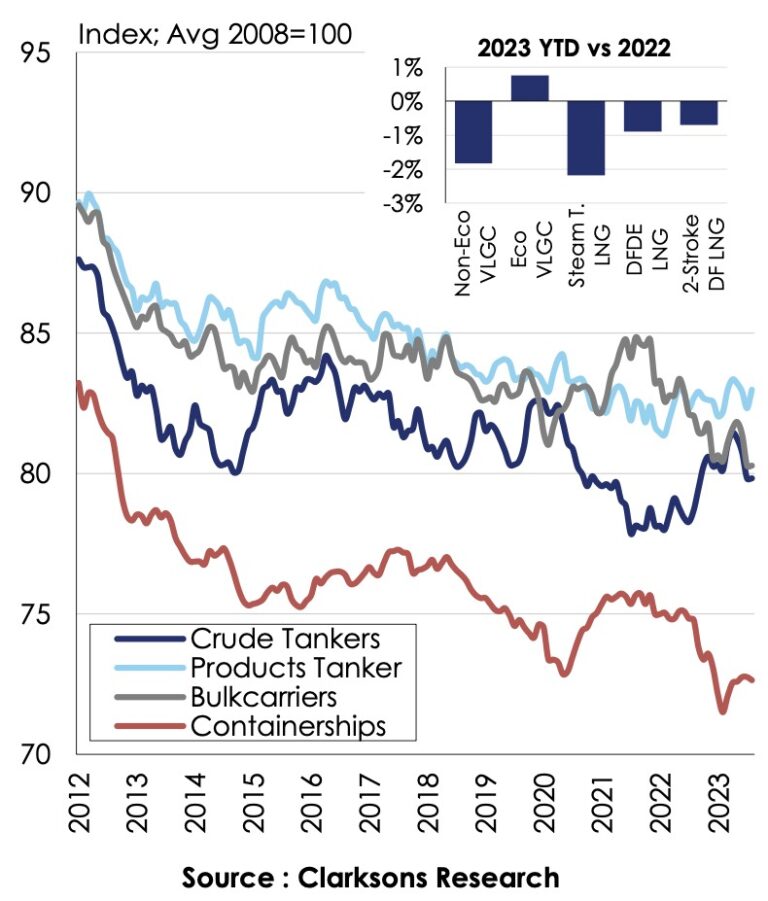
Slow steaming is a good way to save on fuel costs and meet the new IMO requirements. So ships have slowed down. But I was amazed at the graph below, showing a trend for quite a while.
Slowing down is an important way of cutting CO2 emissions from fuel oil. It also implies that more ships are needed to meet planned sailings on a scheduled route. It’s a deliberate reduction of individual ship ‘productivity’, since fewer paid cargo-carrying trips can be made in a year. But it may be a better fit with the demand for shipments right now, and it might result in fuller vessels.
We should remember that slow steaming will not eliminate CO2 emissions problems; it’s a stopgap at best. New types of power with very low or zero emissions through their life cycle well-to-wake must be developed. The investments have to be made.