Tag Archives: green shipping

WASP project ends as winds blow fair

The EU’s Wind Assisted Ship Propulsion (WASP) project has ended. So far we seem to have favorable findings concerning the viability of retrofitting ships with wind propulsion units in addition to conventional power.

Estimates seem to be coming in at up to 10% savings. This is in the North Sea, where the winds blow heavy. However, 10% is not to be sneezed at. It’s a significant reduction in both energy and GHG emissions.

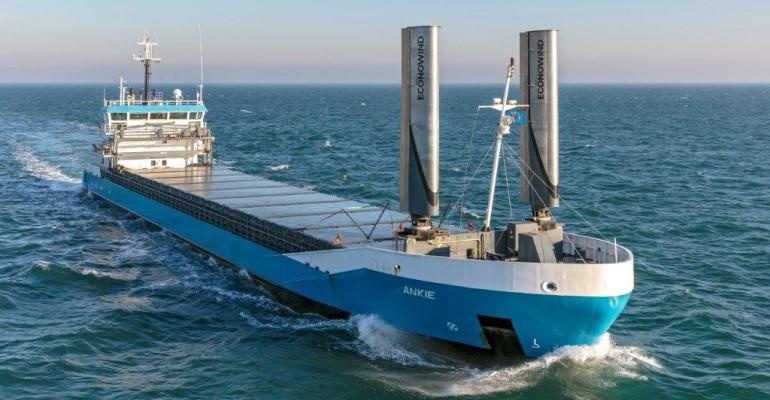
The picture of a bulker fitted with the sails shows one way to add the wind power.

Cooperation between shipowners and technology developers as well as university researchers is key. The list of partners is impressive.

This statement is from their website:

“The project brings together universities, wind-assist technology providers with ship owners to research, trial and validate the operational performance of a selection of wind propulsion solutions on five vessels thus enabling wind propulsion technology market penetration and contributing to a greener North Sea transport system through harvesting the region’s abundant wind potential.”

Source: https://northsearegion.eu/wasp/

WASP has published their last newsletter, and also other publications. It’s interesting reading. There is also a final webinar.

Since I sailed as a kid, I’ve been interested in commercial applications of wind power. It’s exciting to see new engineering marvels tailored for the maritime world. Let’s hope the WASP research will lead to more and better wind power for ships.

Seatrade logo

Paul Bartlett | Jun 30, 2023

WASP project ends as winds blow fair

Anyone got a meth lab?

This article compliments Maersk on their efforts to build a methanol-powered ship, and deploy it in the Baltic running on green methanol. I agree- it’s a great idea, and will actually be green, if they can pull off the creation of the sources of methanol properly.

But the author is less complimentary about how shipowners are approaching the fuel dilemma. He suspects that the craze for dual-fuel vessels is a way to hide the continued use of high-sulfur fuel oil (HSFO). Dual-fuel vessels can operate on methanol or ammonia or hydrogen, but don’t have to. When those fuels are available they could be used. But will they? It will probably be a lot cheaper to use HSFO, for quite a long time. These ships can claim ‘greenness’ without actually being green.

This could especially be a problem for ships reading in the ‘gray’ markets, such as sanctioned shipments. There’s no reason Russia or China for that matter should not continue to accept and make shipments delivered using HSFO. They are not participating in agreements to reduce maritime pollution from hydrocarbons.

It’s a real conundrum, and the splitting of world trade into two camps that follow different rules makes any sort of control harder.

We could be in for a long contest to actually reduce carbon output from ocean shipping.

Andrew Craig-Bennett April 11, 2023

Anyone got a meth lab? – Splash247

No green shipping corridors without landside infrastructure

Green shipping corridors are the latest effort to create strategies for ESG compliance, particularly environmental, for the global shipping industry. These corridors are starting to show up in the planning stages. The intent is to create a connected system of ports that have all the improvements necessary to allow those ships using it to achieve a high level of compliance with green shipping standards.

That means the availability of fuels that meet international green standards such as those of IMO 2022, as well as green technology for loading and storage of containers and other products; and yard equipment that meets green operating standards.

Of these perhaps ensuring the availability of the fuels required is the most challenging. Availability alone is not enough; the price must be competitive, and sufficient storage must be in place; and long-term availability must be assured. The variety of fuels now under consideration for green ocean transport is a challenge. In addition to LSFO, some ships will soon require green methanol; major players such as Maersk and CMA-CGM are investing in methanol-powered ships. And recent studies have shown that fuels can burn greener, but the means of their production and storage have to be included in the fuel evaluation. An interesting study of this was made by Bureau Veritas (BV), a classification society, which described in detail the greenness from well to wake of a wide variety of power options from biodiesel and HS/LSFO to methanol and ammonia. Not all of these are easy to make and store.

So infrastructure will be incredibly important for the green corridors.

Some newly-announced corridors start from Singapore, which already has a large fuel infrastructure, and is a globally important financial center for dealing in fuels. That will be a tremendous advantage. European ports like Rotterdam and American ports like New York already have quite a bit of financial and storage infrastructure. These ports are already part of announced green corridors. However, even at these developed ports some of the alternative low emissions fuels are not available, nor is there the handling capability present.

The interview with the CEO of GCMD casts useful light on what’s needed.

Seatrade logo

Prof Lynn Loo, CEO of GCMD, in an interview at TOC Asia.

Much of the focus in decarbonising shipping is on the vessels, however, without developing landside infrastructure projects such as green corridors cannot take off.

Marcus Hand | Nov 30, 2022

No green shipping corridors without landside infrastructure