Tag Archives: maritime

Green Corridors Hit ‘Realization’ Stage: The Zero-Emission Hurdle

The Getting to Zero Coalition and the Global Maritime Forum have issued a new report At a Crossroads: Annual Progress Report on Green Shipping Corridors 2025. Green shipping corridors are a very impactful way of moving toward zero emissions in the maritime area. They can coordinate many players by providing a specific attainable goal— zero emissions on a specific route for specific ship types. These corridors are independent of efforts by the EU to create incentives and penalties for carbon emissions and reductions, and of efforts by the International Maritime Organization (IMO) to reach a consensus on rules and measures for intrnational ocean shipping. Many times they are organized by specific ports and specific ocean carriers. Often they try to focus efforts on supply chains for specific fuels at those ports.

I think these efforts are extremely important. They can show how to provide reasonably priced fuel supply chains and how to coordinate investors, ocean shipping players, and financial institutions as well as governments. These experiments need to be tried.

The report has been published since 2022, effectively the beginning of the green shipping corridors movement. Steady gains have been made, and today there are 84 initiatives catalogued, with 305 stakeholders. 25 more initiatives have been recorded.

Source: Annual Progress Report on Green Shipping Corridors, 2025.

An interesting section discussed progress at the four corridors that have reached the highest stage in the journey: the Realization stage. Three of them are short-sea routes in Europe. The longest runs bulkers from Australia to China and other Far East ports.

  • Stockholm-Turku ferry, Finland to Sweden, biomethane;
  • Vaasa-Umeå ferry, Finland to Sweden, biomethane;
  • Australia-East Asia bulk carriers, iron ore, ammonia;
  • Oslo-Rotterdam container ships, hydrogen.

I found it interesting that the three short routes fund the difference between green and dirty fuels by entering pooling agreements to sell credits to other shipping lines, under the EU policies. The long ammonia route alone is driven by private firms involved in the trade, to help them meet dramatically lower emissions goals, with fuel costs not funded but expected to drop to a reasonable level as the infrastructure is built out. China, Korea, and Japan all have goals for reduced emissions from shipping which the iron ore route will help with.

Four recommendations emerge from the report’s assessment of the green corridor potential and progress.

  • Pursuing strategies to break the inertia and keep the momentum;
  • Connecting cargo owner willingness to pay to the corridors;
  • Taking an active stance at the IMO;
  • Tapping into or replicating emerging national policy instruments.

Significant issues for now are:

  • Delay of the IMO Net-Zero framework; participants may wait for more clarity.
  • Will the cargo owner be willing to pay for green shipping on the corridor? The evidence so far is not good.
  • Influencing public policies to support investment and regulation.
  • Staying focused on truly green corridors that deploy zero-emission assets rather than fossil fuels, do it early, and iron out the kinks.

This chart shows the right and wrong approaches:
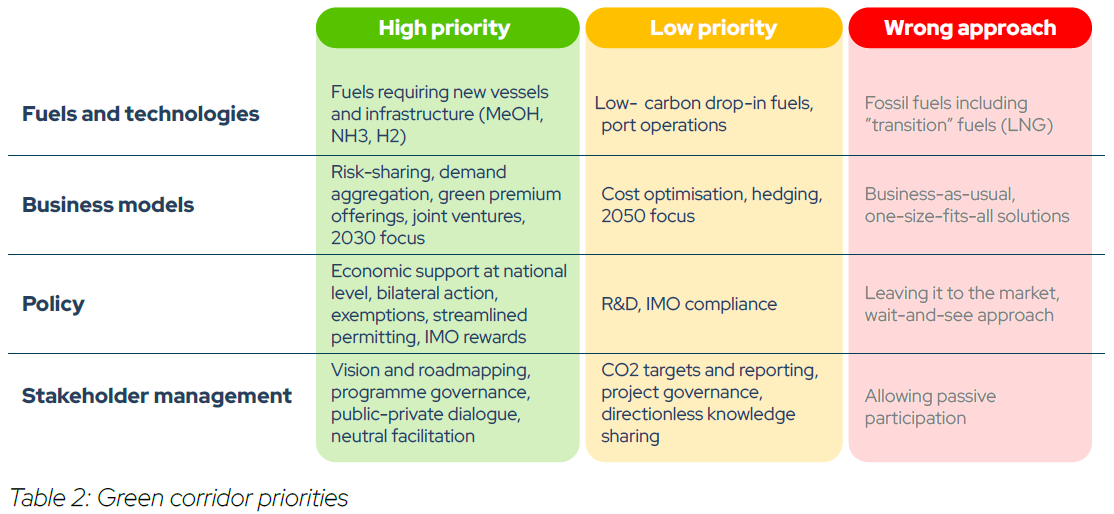
Source: Annual Progress Report on Green Shipping Corridors, 2025, page 25

The study is available in PDF at this link. It contains an Appendix listing all the current Green Corridors in the portfolio at present.

I was very happy to read this summary of the state of green corridor adoption. Keeping this movement going will play an important part in maritime decarbonization.

Gary Howard, Middle East correspondent November 27, 2025

https://www.seatrade-maritime.com/green-shipping/first-four-green-corridors-hit-realisation-stage

Gard emphasizes the S in ESG

ESG is an emerging concern for the maritime industry. And often the focus is on the E for environment. But the S for social good is equally important, and demands more attention. For the maritime industry, the S is many times seafarers and their well-being.

Gard is one of the premier P&I clubs offering marine insurance. It’s based in Arendal, a small Norwegian port city. Gard provides a mutual insurance service covering a wide range of liabilities that may arise from the operation of a vessel, such as pollution, cargo damage, collision, other third-party claims, and of course crew-related matters. 

Gard claims to insure about one-fifth of the world’s seafarers. The top cause for marine casualties and accidents is human error and so it makes a lot of sense for Gard to focus on improving the working environment for seafarers, as better conditions, security and support can reduce distractions and lead to safer ship operations. Gard takes its role as a leader in the P&I marine insurance industry very seriously and is especially proactive in ESG practices.

‘We started a process in 2017 to look at ESG and sustainability more systematically, and how we as a company could make a positive contribution,’ says Rolf Thore Roppestad, Chief Executive of Gard. ‘At the end of the day, we insure people, the environment and property, so our business is all about ESG….We work to make sure they get medical treatment when needed, that they have fair and clear working contracts and that they are compensated if something happens. This is the ‘S’ in ESG.’

An example of Gard’s forward looking approach is their new digital app, the International Mariners Medico Guide, launched in December 2022. It’s free to download, and gives seafarers immediate help and support, even without wifi access. Anyone can download the app, but you must log in with your call sign or IMO number to use it.

The app can be used right at the spot of an illness or accident. That’s of great value. It also can be updated continuously with the latest information for proper care. For instance, emergence of a new virus can be covered as soon as the care information becomes available onshore. ‘For us at Gard, it’s all about being able to help,’ says Lene-Camilla Nordlie, Vice President and Head of People Claims at Gard. ‘Taking care of people is the most important thing that we can do together with the ship owners and the employer. Covid triggered much-needed attention to the challenges of crew on board, and especially that more needs to be done to support mental health,’ she adds.

It is good to see that important firms are taking an interest in seafarers, and working to help them maintain their health and safety.

Vice President, Head of People Claims, Lene-Camilla Nordlie and Chief Executive Rolf Thore Roppestad

(Photo credit Mona Hauglid)

UMAS report details green priorities for shipping

UMAS is an acronym for University Maritime Advisory Service, a commercial advisory service, or consulting firm, focusing on the maritime segment. It makes use of the University College London shipping team as subject matter experts, and takes on relevant projects for the maritime industry.

Recently they’ve released a report entitled A Strategy for the Transition to Zero-Emission Shipping, which tries to spell out ways that a pathway to a 1.5 degree Centigrade increase could be found. It’s an interesting study because it deals with not only the science-based facts about fuels and propulsion systems, and ship designs, but also with the organizational, regulatory, private investment, and geopolitical aspects of a transformation.

The study outlines three scenarios for a fuel transition away from fossil fuels. These are:

  • A spread from a strong first-mover country to others
  • Independent spread from several countries
  • Global actions (such as the IMO) to drive international spread.

The report goes on to identify levers for change in each scenario, covering three phases of the transition to 1.5 degrees C. The phases are Emergence, Diffusion, and Reconfiguration. They are captured in Figure 19, on page 67 of the report. Here you can see the importance of developing new technologies and investing to expand deployment in the first two phases.

The question they address is how to get all the factors necessary to work for the change in each phase. Especially important are the Energence and Diffusion phases, partly because that’s where we are now, and partly because success there largely determines how we reach the final phase.

The report sees a place for all three scenarios in the effort. It’s quite clear about how companies, governments of states, and international organizations could participate and make the transition easier.

One interesting point is the attention paid to constructing green corridors between different ports, both domestic routes and international ones. The green corridor movement is a powerful driver, and there are now lots of examples starting to appear; they are outlined in the report. The analysis is quite detailed, with actual corridor possibilities outlined, and key national players identified. Experience with the difficulties of establishing them will be important to make the process easier in the future.

The report is also positive about the IMO and its role, while acknowledging some of the difficulties relying on it introduces.

It’s quite an exceptional work, and I recommend reading it. I wish I’d been part of it!

You can read the report pdf here:

Sam Chambers April 5, 2023

UMAS report details green priorities for shipping this decade – Splash247

 Sam Chambers April 20, 2023

IMO study makes the case for more ambitious green targets