Tag Archives: ports

How China Uses Shipping for Surveillance and Control

Beijing’s global maritime operations double as intelligence-gathering outposts.

I was not aware that Chinese interests have installed operating software at quite a few ports around the world. Coupled with the Chinese Government’s mandate to share all information with the Chinese Government, we have an ideal spying network. Port traffic is a clear indication of material movements, and could give insights useful for military action.

The article in Foreign Policy, clearly labeled ‘argument’, suggests that the US government examine the risks and take actions to thwart the use of port information. It’s not unlike the US Government stance on Huawei components for cell phones. That fear led to a ban on Huawei selling components in the US.

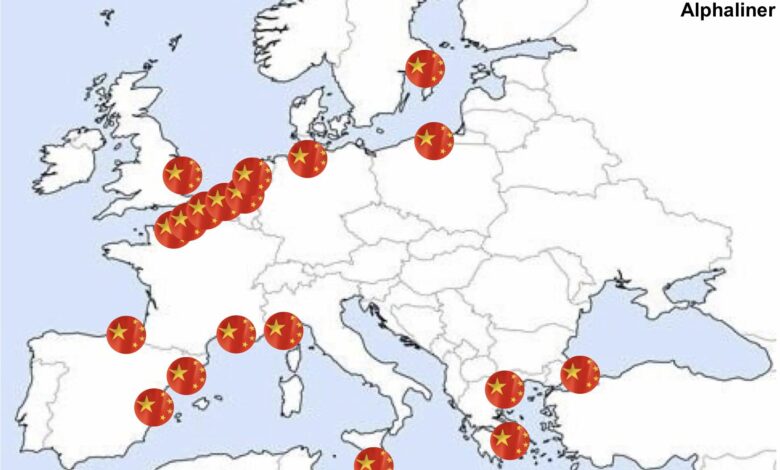
Europe has a problem too. This map from Alphaliner shows which ports in Europe have Chinese interests.

Of course, they aren’t controlling except at Piraeus in Greece and Zeebrugge in the Netherlands. And 23 of them arise from state-owned Chinese interests, China Overseas Shipping Company (COSCO) and Terminal Link, a joint venture with liner company CMA CGM.

The EU adopted new rules last December that call for monitoring of potential threats posed by Foreign Direct Investment (FDI) in European assets.

By Elaine Dezenski, a senior director and the head of the Center on Economic and Financial Power at the Foundation for Defense of Democracies, and David Rader, a senior fellow at the Foundation for Defense of Democracies. SEPTEMBER 20, 2023, 4:46 AM

How China Uses Shipping for Surveillance and Control

By Gavin van Marle 21/09/2023

Are China’s ports and shipping companies being used to spy on the world?

Sam Chambers September 20, 2023

China’s European port interests mapped

West Coast container ports hit by labor actions

Apparently the negotiations between the Pacific Maritime Association (PMA) and the International Longshore Workers Union (ILWU) are not going well over wages.

Some peripheral issues have been settled, but union workers want a share of the massive profits generated by the container carriers during the COVID time. PMA represents ocean carriers and terminal operators in the negotiations, and some terminals are controlled or dominated by a carrier or a group of them.

I think that is appropriate. Anyone’s analysis of the labor economics of unions will indicate that unions only have occasional times when they have any leverage over their terms of employment. This is one of them.

They should be expected to bargain hard for wage increases because they have not had a new contract since 2015. A lot of water has gone under the bridge, including massive profits for ocean liner firms. Longshoremen played a large part in the successful import and export of all those containers.

The PMA has not had a good record of conducting these negotiations, sometimes playing hardball when their sponsors would have liked a little softer approach. It’s true that the ILWU is known for its intransigence also.

But now the PMA should make a realistic offer. Inflation is high, there’s no prospect of it moderating very much very soon, and there are all those past years to make up for. Longshoremen deserve to be paid fairly for their work in the light of present, and possibly future, economic conditions.

These incidental stoppages for short times are just warnings. Neither side should want a general strike, because the new increases in West Coast shipping, after a long decline, are just emerging. It’s true some traffic has left for the East Coast, but the facts are that West Coast ports that operate well are still the fastest and most reliable way to ship to America from the Far East. If they are seen as reliable, traffic will return.

Time to step up and make an offer longshoremen are likely to accept.

Greg Miller Sunday, June 04, 2023

West Coast container ports hit as labor talks take ominous turn

Work resumes at LA/LB ports, but contract settlement stays out of reach

There’s no labor agreement in sight for West Coast ports. And recently there have been short unannounced work stoppages by the unions.

I’m thinking these work stoppages are trial balloons. The major union at the ports, the International Longshore and Warehouse Union (ILWU), may be trying to gauge the impact of a stoppage on the ports. We all know that the ocean shipping market is weak, and in addition quite a bit of container traffic has moved away from the West Coast ports, to the East Coast. So volumes are down at the West Coast ports.

It’s possible that cargo volumes are so light that a full strike will jeopardize the ports’ business. A sizeable reduction in container traffic would reduce the demand for longshoremen and union workers. They don’t want to kill the golden goose. A mini-trial would tell them whether the ports would be severely hurt by a strike. Otherwise the ports might say “Go ahead and strike!”

I think that is why the US government is loath to intervene yet. Continuing to negotiate might be the best way to get an outcome everyone can live with.

Ian Putzger, Americas Correspondent 11/04/2023

Work resumes at LA/LB ports, but contract settlement stays out of reach – The Loadstar