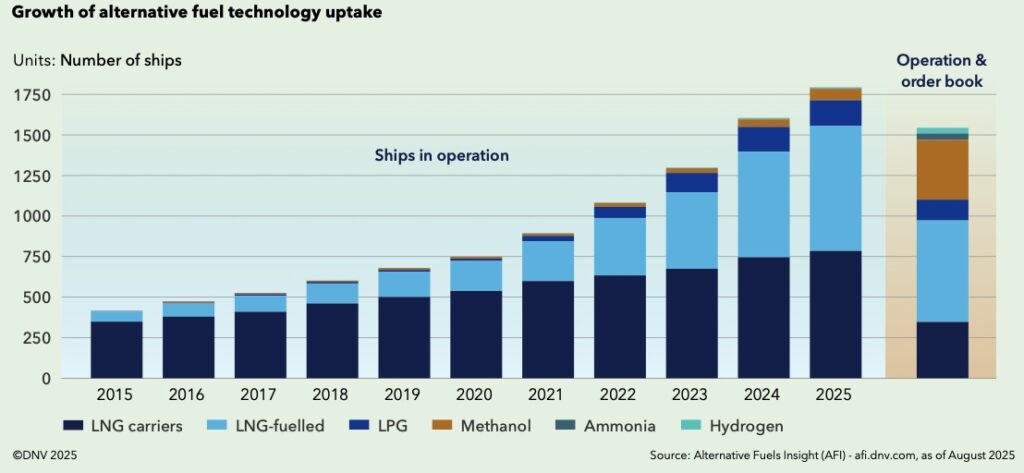
DNV, a major classification service for the maritime industry (it stands for Det Norske Veritas), is reporting that accounting for newbuilds that can burn alternate green(er) fuels, the bottleneck will be the supply of these fuels for maritime use.
It calls the phenomenon a “fuel transition tipping point”. It’s a strong demand signal for fuel producers. The graph shows the exponentially rising number of alternative fuel ships in the fleet, and adds the order book for the future. Methanol seems to be increasing quickly.
The infrastructure just isn’t there yet, and bunker operators and fuel producers need to step up their investments.
Green corridors are one approach that is gaining traction. In this scenario, several partners join forces with ports, fuel producers and bunker operators to make sure the infrastructure is there for fueling with green fuels on the route, usually point-to-point. Maersk has been a leader in this effort. Others are getting on board.
You can read the DNV maritime forecast to 2050 report here.
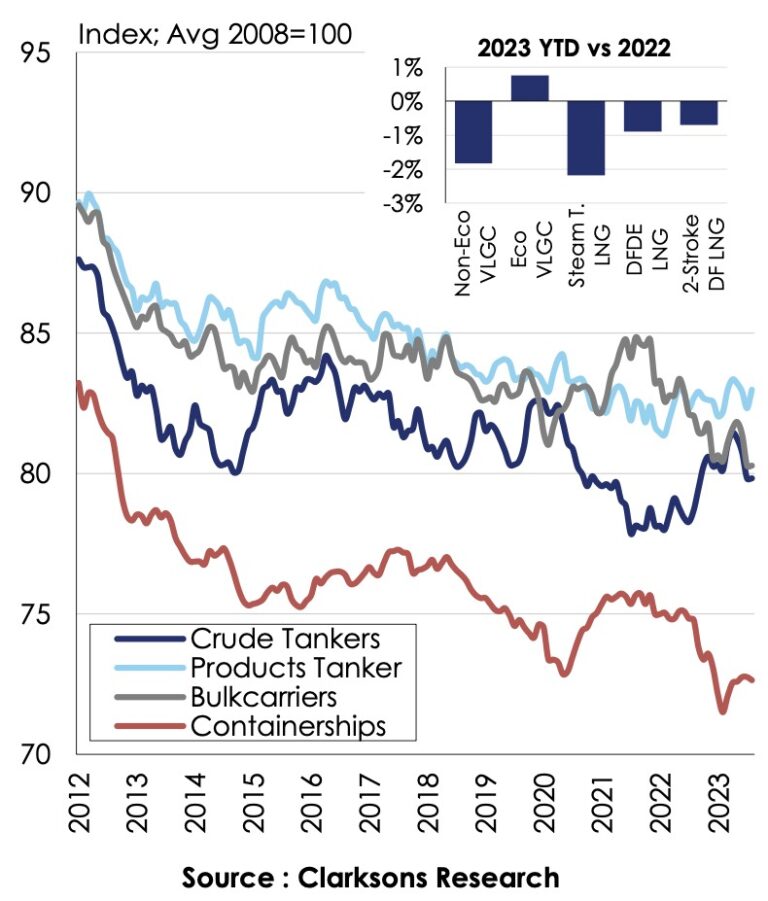
Slow steaming is a good way to save on fuel costs and meet the new IMO requirements. So ships have slowed down. But I was amazed at the graph below, showing a trend for quite a while.
Slowing down is an important way of cutting CO2 emissions from fuel oil. It also implies that more ships are needed to meet planned sailings on a scheduled route. It’s a deliberate reduction of individual ship ‘productivity’, since fewer paid cargo-carrying trips can be made in a year. But it may be a better fit with the demand for shipments right now, and it might result in fuller vessels.
We should remember that slow steaming will not eliminate CO2 emissions problems; it’s a stopgap at best. New types of power with very low or zero emissions through their life cycle well-to-wake must be developed. The investments have to be made.
This article features an interview with Michael Webber, who has been tracking corporate governance in ocean shipping firms since 2016. He produces an annual corporate governance scorecard for shipping, now at his own firm, Michael Webber Research and Advisory.
One significant issue in shipping is the constantly changing mosaic of companies. Firms are constantly merging in companies and creating new spinoff firms, some containing only a single ship. It’s a chore to keep track of it all, let alone try to rate how well the firms are looking after shareholders. The ratings Michael provides are simply to inform readers of the practices the firms engage in. This helps investors and traders to understand whether the firm is practicing good corporate governance or engaging in bad practices.
Webber claims that companies that score low on his rating have trouble raising capital using equity. He thinks investors are becoming more selective. It’s not only affecting stocks on the market; IPOS are failing due to governance issues as well.
There are a lot of related party transactions in shipping. Some benefit public investors and some don’t. Because no one was looking very hard in the past, it can be complicated for an older firm, say from the 2000’s, to unwind old structures that were not examples of good governance. Some firms have been successful doing this, but Webber says shareholders are at an informational disadvantage when these transactions are proposed. His rankings try to shed light on the corporate governance of the actors, for the benefit of the shareholders.
Webber thinks governance is improving overall, and shipping has improved its image on Wall Street. His ratings help public shipping companies find opportunities to conform to best practices in governance, and that improves the image and reality.
The scorecard rankings for 2023 are shown below.
(Source: Chart: Webber Research & Advisory)
The stock symbols of each firm are given. Webber has marked the firms that make no carbon disclosures.
Update: The University of Plymouth and the National and Kapodistrian University of Greece have announced a new ESG index to be revealed September 11th. It will be interesting to compare their work against Michael Webber’s.