Category Archives: Managerial Econ

Posts relevant to Managerial Economics.

Liners get a preview of alternative fuel costs

A new technical and commercial comparison of alternative fuels for ocean carriers compares expected bunker costs for different size and differently equipped ships. Alphaliner, a consultancy for ocean carriers, has reviewed that comparison.

Alphaliner’s review shows the ship owner and operator what they can expect in economy over the next few years. The results indicate that as the new regulations for CO2 emissions kick in, fuel costs will become a much larger percentage of total ship operating costs, perhaps double, or even more.

For instance, the graph they publish shows fuel costs for differently equipped Megamax-24 (MGX-24) ships. A megamax-24 ship is typically 400 meters long and 61 meters wide, with a depth of about 33.2 meters. It should carry around 23,500 twenty-foot equivalent (TEU) containers (Alphaliner newsletter).

The graph compares use of fossil fuels, bio fuels, and power-to-fuel (PtX) fuels (read about them). The PtX fuels convert renewable sources such as wind, sun, hydro, and geothermal, to fuel products such as hydrogen, ammonia, or products containing carbon, such as syn-crude. If carbon is used in the PtX process it should be from non-fossil sources or unavoidable industrial carbon emissions capture and reuse.
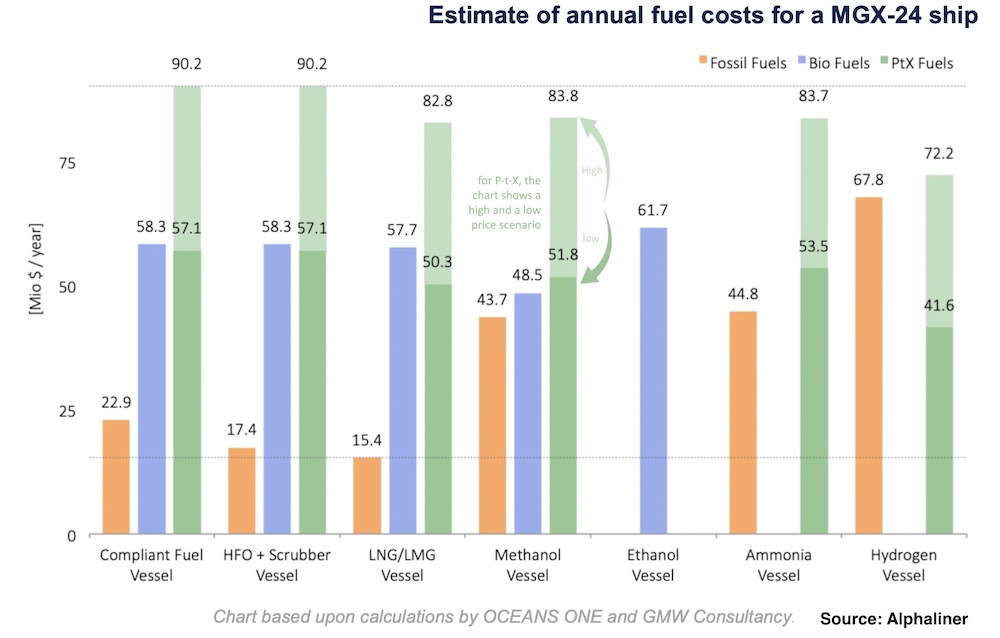
Source: Splash247 article.

Even bio-fuels cost a lot more than conventional fuels when all the upstream supply chain emissions are considered, for these very large ships.

The graph seems to imply that scrubbers are still a very important technology in the fight to clear the air. And LNG has a role to play, though it might be temporary. At their best, the PtX technologies such as electric-powered ships are comparable to or better than bio-fueled vessels.

There’s clearly a long way to go for ocean shipping to go where it needs to in the race to clean up global emissions.

However, some of these non-fossil technologies will adapt over the next few years, and costs will come down. It’s hard to do much more with the fossil fuel technology.

The argument Alphaliner makes is that soon fixed costs will be a smaller part of the total cost of a large ship than fuel operating costs. As these proportions change, emphasis will come more on building ships with desirable emissions control power systems, since the availability and price of fuel will be driving overall costs.

That’s an interesting point. We will see the extent to which it influences the next generation or two of ship orders.

Sam Chambers July 27, 2022

Liners get a preview of alternative fuel costs – Splash247

Truck freight matching as factoring

Some large unicorn startups are targeting freight matching for truckers as a great way to guarantee better utilization of trucks for smaller independent truckers, and offer the additional benefit of helping sustainability. Empty return trips are definitely a source of unnecessary air pollution.

Two big ones are Convoy in the US, and Zeus Labs in the UK. The concept is Uber-like and simple: match freight that has to move with trucks looking for a load. It’s easily handled with software. So far, so good.

Now these large, well-capitalized firms are using their financial power to offer factoring to their trucker clients. In effect, the truckers are selling their freight invoices to the large firms for ready cash of something like 80% of the value. The claim in the article is ‘up to 85%”. It’s up to the factors then to collect the full value of the invoice, possibly as much as 90 days later. This is due to the ‘slow pay’ practices of many shippers.

This factoring or loaning of money could be useful for a trucker, in order to get paid right after delivering the load. The question is whether the price is right. The factor can make a lot of money due to the reduced payment for the invoices. It clearly is a good business for the factor.

But as in small business everywhere, it’s not always the best policy to sell your invoices for early money. The discount may be too high to offer a decent profit on the trip. Truckers might be trapped by the idea of quick money into reducing their profits from each load by too much to sustain them. It’s a classic small business risk, that has to be examined closely.

I’m not sure truckers are all prepared to make this evaluation. But the offer of early payment can be attractive.

By Charlie Bartlett, Technology Editor 25/04/2022

Frenzy of investment as truck freight matching oils the wheels – The Loadstar

FMC to consider regulating ocean carrier billing practices

Demurrage and Detention are on everyone’s minds in ocean logistics today. The FMC proposes to regularize the information and timing of billing practices.

This could be very helpful in reducing the chaos of D&D billing today. It’s impossible to tell exactly which incidents happened when, and even who should pay. Those kinds of questions must have evidence to settle them, and it’s not being provided in bills. That results in long conversations and debates over the bills. It’s a huge time-waster, and fertile ground for complaints, refusals to pay, and legal action. These add cost while reducing consumer value.

In any principal-agent situation, when the cost of monitoring rises too much, the overall deal can’t be made. D&D charges are part of the cost of monitoring ocean trade. And in principal-agent models, monitoring costs often take the form of data collection and verification.

For years, ocean container traffic flowed fairly smoothly, and the events that triggered D&D charges did not happen very often. In those days, perhaps we could get away with settling claims by email and phone discussion. But with massive congestion worldwide, and only weak motivation to pick up empty containers, those days have changed.

We need accurate information for the parties to be able to resolve the D&D charges, and get the right bills paid by the right party. The FMC has it about right to take this first step, to regularize the bills.

Once that happens, if the D&D problem continues to be big, firms will recognize the value of investing in correct data gathering, and sharing it, and establishing standards for handling it.

John Gallagher, Washington Correspondent Monday, February 7, 2022

FMC to consider regulating ocean carrier billing practices – FreightWaves