Tag Archives: container shipping

DPW to deploy first Boxbay stacking system at Pusan Newport

Here’s an innovation that’s going to be popular at container terminals. It’s a fixed set of frames allowing containers to be stacked in individual pigeonholes. They’re placed and removed by stacker cranes running through the aisles. The system has been in development and testing since 2018.

Hardware innovations take a long time to develop, and they require a place for testing. The partnership of DP World and SMS Group, a German firm, combined the expertise and the need and test bed to create the product.

Stacking density may be improved up to 4 times using the Boxbay system.

This is not a new idea. Auto manufacturers and shippers have been using such arrays to store cars since the 90’s. I was shown a picture of one in Japan by Ernest Konigsberg, a Berkeley operations research professor who was familiar with the design and the optimizing software written to decide which locations to place vehicles. We would call it AI today, but then it was simply optimization software. It’s been around a long time.

An interesting question is why this technology is only emerging now. One answer is the Great Congestion about the time of the COVID epidemic. Yard storage was a significant problem during the supply chain crisis. This kind of system can improve the utilization of scarce container yard land. It’s a natural type of tech to invest in.

I’m sure we will see more such systems if container shipping demand comes back and exceeds the congestion period levels. But if ports aren’t handling so many containers, they may not be so eager to invest in this technology. I don’t see the large US ports jumping on this so soon, with traffic falling.

The article has a nice picture of Pusan Newport terminal, and judging by the stacking disarray in the right part of the picture, they can use this system1

By Nick Savvides 08/03/2023

DPW to deploy first Boxbay stacking system at Pusan Newport – The Loadstar
Xeneta green scheme names and shames box line heroes and villains

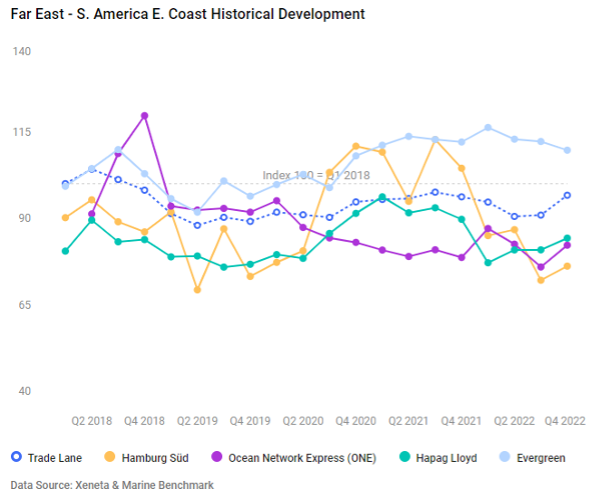
Xeneta has developed a new index to describe the CO2 emissions by major container shipping companies on specific trade lanes. The index names Hamburg Sud as a hero and Evergreen as a villain currently.

Unlike the IMO’s CII the index estimates CO emissions per unit of cargo, which may be a better measure for carriers to work on. It also lets Xeneta make a statement on how the line got their result.

For instance, Hamburg Sud got their good result mainly by slow steaming.

Here’s what Xeneta had to say about how the index is calculated:

“The CEI methodology, she explained, is based on data from Marine Benchmark and calculated based on AIS data, including speed, combined with modelled factors, such as weather data, loading.”

Source: article linked below.

We’ll want to follow this CEI index over time. Over time Xeneta gives us a graphical picture of several entities on the America East Coast trade. Here we see how various carriers and consortia are able to manage CO2 emissions via the CEI.

By Charlie Bartlett, technology editor 09/02/2023

Xeneta green scheme names and shames box line heroes and villains – The Loadstar

Intermodal truckers secure win against ocean carriers

The chassis world is always coming up with a new twist.

Two large chassis pool operators, in Chicago, LA/Long Beach, Memphis, and Savannah, have to allow truckers to use a provider of their own choosing.

The formation of chassis pools about 10 years ago was sparked by ocean carriers’ desire to stop providing chassis. The reason given was that US rules on who is responsible for damages if there is an accident placed the burden on the chassis owner. To escape, the ocean carriers decided to leave the chassis business in the US. That’s typical worldwide; for instance, in Europe most chassis are owned by trucking firms.

But how do ocean carrier customers in the US get chassis to move the containers once they are off the boat? A game theory analysis (Hartman, Bruce and Christopher B. Clott, 2014) showed that truckers would not buy chassis unless they were virtually certain (over 90%) that the shipper would use their chassis rather than deal with the ocean carrier for one. Cargo gotta move — so the ocean carriers needed to find a way.

The answer was ‘chassis pools’. Ocean Carrier Equipment Management Association (OCEMA) developed Consolidated Chassis Management(CCM) to form and manage pools of container chassis at various ports to insure that chassis would be available for cargoes.

Clearly the pools were an advance. Pooling always allows demand to be satisfied with smaller inventory; it’s essentially a newsvendor situation. One big issue, however, is maintenance. A trucker expects to be given a chassis that is in good repair, and will probably not need maintenance during the trip. In the US, the trucker is responsible for on-the-road maintenance. So the question arises— how diligent will pool operators be in maintaining chassis that are turning over quickly?

That question alone was the spark of a putative strike at the LA/Long Beach pool. The union wanted to have control over workers at the pool yard, who were doing the maintenance. It became a big deal in the union negotiations. And the union won– union workers were hired to staff the yards. This went some distance to resolve the problem since the quality of the workforce was controlled by the union and not the owners of the yard.

All this sounds good so far. But issues can arise when individual carriage contracts are made. To what extent can carriers specify what equipment is used, and where it must be delivered when empty? What rates will be set for the use? And can contracts be altered while the chassis is moving, to specify return at a different place, or somewhere well off the route of the trucker?

In this case, the Administrative Judge ruled that motor carriers cannot be forced to use pool chassis; they may use their own chassis source. It’s a victory for truckers. There’s a tricky question of ‘default chassis provider’ when the contract does not specify the chassis source, but it’s clear now that the Judge wants truckers to be free to use their own provider.

That’s a win because it puts truckers in control of their chassis source, and frees them from potential hassles over contracting and repairs they might get into with CCM. They can manage their chassis choice themselves.

It’s interesting that over 9000 pages of documents were filed in this proceeding. Clearly both sides felt there was something to argue.

John Gallagher·Monday, February 06, 2023

Intermodal truckers secure win against ocean carriers – FreightWaves

FMC Summary Decision Text