We have needed direct rail from LA/Long Beach to the East Coast for a long time, as long as I’ve been watching California Logistics. There hasn’t been anybody with the power to force it into existence. The West Coast Ports would have been wise to fertilize such an arrangement years ago.
It would cut logistics emissions and costs for many shippers.
Now comes Amazon. They have the market power in logistics and shipments to make it happen. Amazon partners, and that includes most anyone with any volume, can choose this service for ocean freight through LA to Amazon’s East Coast fulfillment centers. It’s called Amazon Global Logistics Standard Ocean Express.
Amazon has not named the rail partner, nor published rates, nor identified which fulfillment centers it will deliver to.
We can guess that it will be faster than many current rail offers, and faster than trucking. It would not be hard either to route around the ‘Chicago bottleneck’, the switching yards causing delays in the Chicago area, or, with enough volume, force better performance there.
BNSF already is investing in faster rail with their Barstow area intermodal transfer yard, and has an agreement with CSX in place for full East Coast access. It will go by way of Kansas City. And the UP merger with Norfolk Southern (NS), if it goes through, will provide a competitive coast-to-coast route.
Amazon has quite a few major customers who will possibly find this offer attractive. Procter & Gamble, 3M, Lands’ End, and American Eagle Outfitters are three early customers for Amazon Supply Chain Services.
It should have happened years ago, but better late than never.
The CSX (NASDAQ: CSX) first-quarter financial report was very positive. It showed over 5 percentage points improvement in the operating ratio, to 64%. Operating ratio is a metric much watched in the rail industry, as it shows how efficiently the line is moving and using equipment. The formula for calculating the Operating Ratio is:
OR = 100 * Operating Expenses / Operating Revenue
What it Covers: Operating expenses typically include fuel, labor, equipment maintenance, and materials. It does not include taxes, interest, or other non-operating costs. In particular it doesn’t cover capital improvements to the rail line and equipment.
The industry benchmark for this ratio is in the low 60s or even high 50s, when the so-called “Precision Scheduled Railroading” (PSR) strategy is in place. Invented by Hunter Harrison, at the Illinois Central Railroad, PSR began as a series of ‘lean operations’ improvements including speeding up interchange of equipment, and making sure trains interacted on time and customer loads were routed to meet committed schedules the customers expected. His last stop in leading several railroads was at CSX.
As the concept evolved, cost-cutting became the mantra, and this was realized in the adoption of operating ratio as the measure of success.
But modern implementations of PSR-like concepts have included running longer trains on more spaced-out schedules, reducing crew sizes, lengthening crew working hours, reducing rail staff such as inspectors and conductors, reducing the amount of equipment used such as locomotives, adjusting safety and inspection standards to less frequent review, and using more automated inspection equipment and fewer human inspection hours. Some of these actions are not consistent with the original Hunter Harrison practices, especially when pushed to limits.
There have been protests from rail unions over practices that reduce rail staff and compromise train safety. Some of these have surfaced at major accident sites such as the derailment and toxic spill at East Palestine, OH in 2023, where defect-detection technology failures and lack of human inspection were implicated in the accident. The rail involved was Norfolk Southern (NS).
Intermodal freight increases were instrumental in the financial good tidings presented in the report. And with fuel prices escalating, intermodal should be the go-to choice for shippers looking to reduce their exposure to rising fuel costs. Intermodal freight can replace many highway trucks, and save lots of fuel. More intermodal shifts are required than for straight trucking; but for longer movements, intermodal has been a winner for a while.
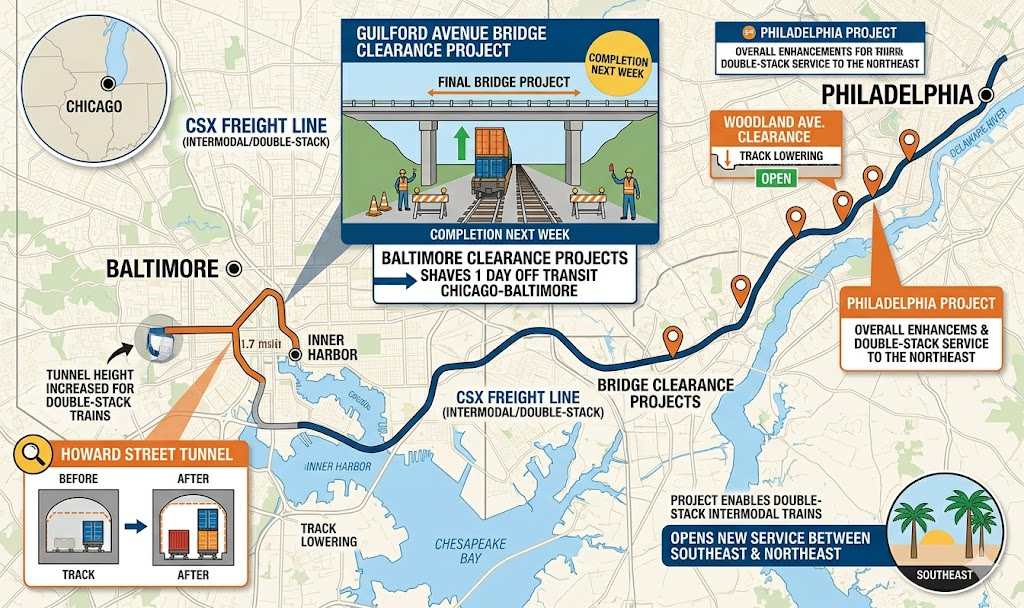
To me the most interesting feature of the report is the pending completion of a new double-stack tunnel and bridge clearance project between Baltimore and Philadelphia. The map below indicates the location of project elements.
A key element is the Howard Street Tunnel project. This capital project allows CSX to run double-stack intermodal trains from Baltimore to Philadelphia, and beyond. It opens the Northeast to improved rail-container traffic from Southeast ports. This will improve transit times for shippers. The project is a capital project, and its cost is not reflected in the operating ratio, but represents CSX making investments of its surpluses in infrastructure that will improve service both long-term and short-term. Especially now, with fuel prices at highs and going up, customers will have a more reliable and sustainable alternative to trucks.
CSX also made improvements in its intermodal terminals and interchange in the Chicago area, removing bottlenecks of long standing at the Barr Yard. Chicago has been a bottleneck for East-West transfer for many years, and relieving it should have been a major priority for years. CSX’s action is important because of potential competition with the potential merged rail UP (Union Pacific) and NS, which will create a coast-to-coast national rail service with more leverage to eliminate its bottlenecks.