We have needed direct rail from LA/Long Beach to the East Coast for a long time, as long as I’ve been watching California Logistics. There hasn’t been anybody with the power to force it into existence. The West Coast Ports would have been wise to fertilize such an arrangement years ago.
It would cut logistics emissions and costs for many shippers.
Now comes Amazon. They have the market power in logistics and shipments to make it happen. Amazon partners, and that includes most anyone with any volume, can choose this service for ocean freight through LA to Amazon’s East Coast fulfillment centers. It’s called Amazon Global Logistics Standard Ocean Express.
Amazon has not named the rail partner, nor published rates, nor identified which fulfillment centers it will deliver to.
We can guess that it will be faster than many current rail offers, and faster than trucking. It would not be hard either to route around the ‘Chicago bottleneck’, the switching yards causing delays in the Chicago area, or, with enough volume, force better performance there.
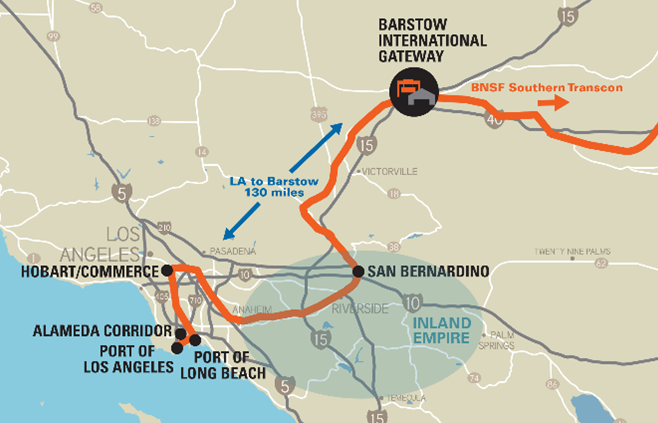
BNSF already is investing in faster rail with their Barstow area intermodal transfer yard, and has an agreement with CSX in place for full East Coast access. It will go by way of Kansas City. And the UP merger with Norfolk Southern (NS), if it goes through, will provide a competitive coast-to-coast route.
Amazon has quite a few major customers who will possibly find this offer attractive. Procter & Gamble, 3M, Lands’ End, and American Eagle Outfitters are three early customers for Amazon Supply Chain Services.
It should have happened years ago, but better late than never.
Here’s a project that should have happened 20 years ago.
California’s major ports, at Los Angeles and Long Beach, have been desperate for relief from drayage traffic for containers they bring in. It was a struggle to get rail to the ports so that containers could be directly loaded. In 2002 the Alameda Corridor began to move double-stack double-track trains from near (but not on) the ports to the San Bernardino area. But rail service to the bulk of the US was still elusive. Transloading to 53-foot truck containers was the main activity in the Eastern valley. And that led to more truck traffic on the already busy freeways.
Remember that in the earlier days, pre-COVID, the land-bridge was still a preferred route from Asia to Europe. Ship to LA/Long Beach, Rail to New York or another eastern port, and ship again to Europe. It was lower cost and shorter time than any other Asia-North Europe route. And that included the numerous delays in moving goods by rail out of the port areas.
The problem has been urgent because of air pollution from the many drayage trucks traversing the area. California has been trying to address this problem from many directions. One of the first methods was the Clean Trucks program, which banned engines earlier than 2007 carrying to and from ports, and imposed other requirements on NOx and particulate emissions, especially PM2.5, a demonstrated pathogen for breathing problems. Gate reservations came next, as an attempt to articulate delivery and pickup with container movements in the yard.
But many noticed that switching from truck to rail would cut pollution even faster, and perhaps even improve efficiency. Numerous researchers, including my coauthor Chris Clott and me, suggested that moving functions off the port quickly to inland sites, called inland ports, would work. We even suggested, back when the land-bridge was functioning well, that inland ports as far away as Chicago could boost efficiency. The ports were not interested at that time.
Meantime, the ports and private firms have invested in the Alameda Corridor, which took double-stack, double-track trains through a frantically busy melange of LA suburbs, with many overpasses and intersections that had to be rebuilt, and many regulatory challenges.
Now finally, BNSF, a major Class I railroad, one of two serving the West Coast, has committed to a large inland rail intermodal terminal. It’s near Barstow, CA, out in the desert, kind of toward Las Vegas. This large inland port will be able to eliminate over 200 million truck miles by its completion in 2028.
The latest yard technology will be used, including zero-emission cranes, forklifts, and hostlers, electric plug-ins for refrigerated containers, and hybrid rubber-tired gantry cranes. BNSF has also committed to use the cleanest available switching locomotives in the yard.
The project is appropriately nicknamed BIG (for Barstow Intermodal Gateway). The press release says “By relocating container sorting and processing from congested port-adjacent communities to Barstow—a high desert hub with strong transportation infrastructure—the project enables a major mode shift from trucking to cleaner, more efficient rail.”
California and its residents are serious about industry controlling pollution.
Christopher Clott, Bruce C. Hartman, Supply chain integration, landside operations and port accessibility in metropolitan Chicago, Journal of Transport Geography, Volume 51, 2016, Pages 130-139, ISSN 0966-6923, https://doi.org/10.1016/j.jtrangeo.2015.12.005.