Tag Archives: economy

Resilience blind spot in shipment routing

Companies have done a lot of work on supply chains in the last year to improve their resilience to geopolitical glitches. It’s been hard work to diversify suppliers to different countries to lessen risk.

But another form of risk is control of the terminals and transfer points on shipping routes. The article here notes that the port of Shanghai in China has grown at over 6% annually, even though the Chinese economy only grew at 3.5%. What’s using all that capacity? The answer is that many shipping routes still move through Shanghai even though the origin and final destination of the cargo is not in China. The routes themselves are subject to disruption if relations with China sour.

It’s also worthwhile to point out that Chinese entities control or have major financial interests in many ports round the world. If a shipper really wants to assure some independence from China, she will have to examine their shipping routes as well as the country of origin.

Is there a way to look at this connectivity? The article suggests an analysis by SKU of the port connectivity involved in the supply. A high-level indicator is provided by UNCTAD’s port connectivity index, available at this link.

To see how the index works, read this: https://unctad.org/news/new-context-calls-changing-how-we-measure-maritime-connectivity The six major components are given here:

  1. Number of direct connections: The more countries can be reached through direct shipping services, i.e. without requiring a transshipment, the faster and less risky is the connection.
  2. Number of weekly calls: The more often ships depart from a port, the lower the waiting time for the shipper.
  3. Number of companies providing services: The more choices shippers have, the less likely they are confronted with potential negative impacts of oligopolistic or monopolistic markets (i.e. higher prices and lower service quality).
  4. A higher number of services is an indicator of shipping options for the importer and exporter. Services may be provided jointly by various carriers, and each carrier may provide several services.
  5. Total deployed carrying capacity: The TEU[i] that can be imported and exported to/ from a country is an indication of the total transport service supply.
  6. Size of the largest ship: Larger container ships are more likely to be deployed in hub ports, providing additional connectivity to importers and exporters from the port thanks to trade between third countries. Also, ports that can accommodate larger ships tend to have better port infrastructure and port services.

The connectivity index is only a rough tool at best for supply chain planners and logistics pros. One needs to investigate the individual routings used for SKUs, and that requires close cooperation and openness with carriers and any third-party firms you use for logistics management.

Furthermore the routing may change even though the carriers involved are the same. So it’s daily attention rather than autopilot. Perhaps this is a job for AI agents. Almost daily checks may need to be made.

Then, what do you do about it? Do you have the power to force a change? Do you want to pay for the change? These are not easy decisions, but they certainly require attention at operational, tactical and strategic levels.

I would not be surprised to see the emergence of startups that can provide dynamic routing visibility and costing, perhaps with AI agents. Such tools can help in the current world scenario. They are most relevant in the fast-changing world political scenario we are in today. That churn is creating costs for supply chains we couldn’t even imagine two years ago.

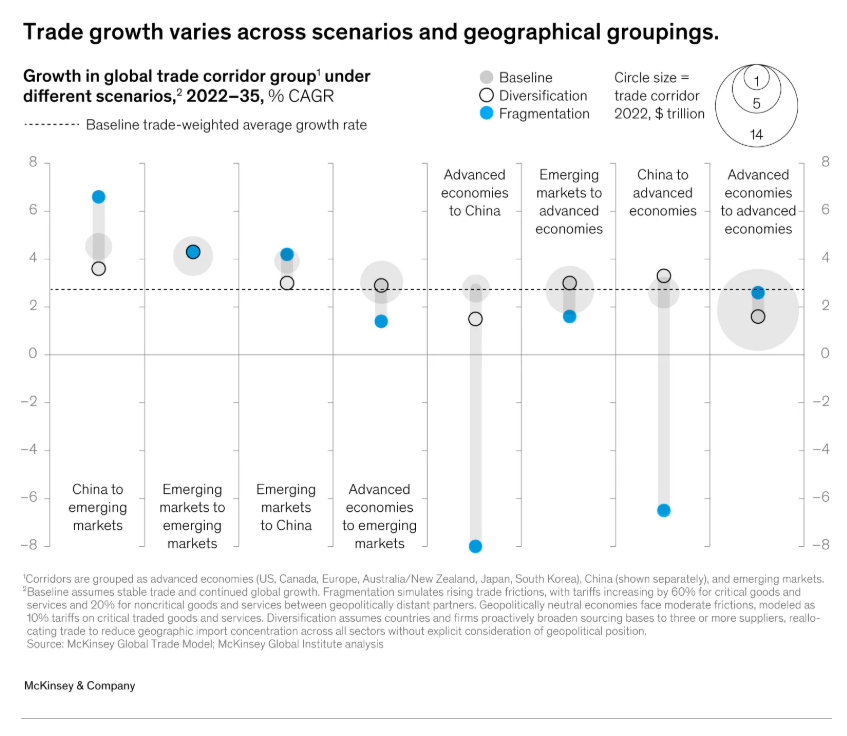
Some scenarios around the trade lanes are presented by McKinsey. The following graph shows some basic geographical groupings and three scenarios of activity, called Baseline, Diversification, and Fragmentation (the worst), over the period 2022-2035. Compound annual growth rates could range from +6% (China to emerging markets) to -8% (advanced economies to China). The source here is this web page. Such large adjustments over a long period means there’s a risk of stranding investments in infrastructure, including ports.

The people of the world will be much better served by open trade rather than fragmentation.

Splash December 15, 2025

https://splash247.com/shanghais-box-boom-exposes-a-resilience-blind-spot/

Supply chain choke points matter!

China expert Leland Miller, co-founder and CEO of China Beige Book International, says that trade is not the issue. The real question is control of supply chain choke points.

These could be supplies of scarce materials, such as rare earths, that are used in worldwide manufacturing processes. It could also be control over key ports or routes that supply products to the world.

Tariffs don’t matter much in this context; they can change, be skirted, or negotiated. Miller pointed out that worldwide, tariffs aren’t actually that high. Control over supply can be used to cut off countries or individual firms that aren’t doing what you want.

Looked at in this light, we can see the China-US struggle over ownership of the Hutchison Panama Canal ports as an effort to control a choke point in trade. We can also see the Houthi effort to gum up the Strait of Hormuz and the Red Sea as a control effort— to improve Israel’s behavior towards Gaza; with the help of Iran. The Hecksher-Ohlin theory of trade says that nations should trade when there is an imbalance in resources of whatever kind– labor, raw materials, educational capacity, agricultural land. And to exploit these advantages to defeat competitors is as old as warfare itself. Miller believes the Chinese are positioning themselves to wipe out economic competition when they see fit.

The US government will then become a participant, and perhaps a controller, of the free markets. That’s already happening as the US government takes a stake in companies here in the US. So it won’t be free enterprise, but government-influenced markets.

I don’t believe selling interests is necessarily our best course as a nation. Business becomes dealmaking in exchange for foreign cash, that evaporates into the hands of a few rich owners. The people, or workers, don’t benefit; instead they see the higher prices brought on by controls on supply.

John Kingston Tuesday, October 21, 2025

https://www.freightwaves.com/news/china-expert-miller-why-supply-chain-choke-points-matter-most

Chinese ships dropped from U.S. routes

It seems that there is enough extra capacity in container shipping carriers’ fleets so that Chinese-built or Chinese owned ships need not be used on Asia-Pacific routes. Carriers have already announced plans to redeploy Chinese-built ships to other routes. So these shipping lines won’t be paying the US port access fees Trump put into place.

Will anyone be paying them? That’s the question now. The Trump administration’s estimates of the revenue these charges will bring in are way too high. No big money for US shipping improvements.

It’s another example of international ocean carriers and shippers’ immense innovativeness when a barrier to trade is erected. These entrepreneurs will always find a way around the barrier. One example here is ships calling at Canadian ports like Prince Rupert or Mexican ports like Ensenada instead of their US counterparts, avoiding the fees, but still able to provide good service via rail into US customers.

Something similar will happen with US tariffs. Enterprises will find a way around the rules.

That’s been happening since the dawn of navigational history, if not before. The American Revolution was in part about avoidance of requirements imposed by England on the shipment of goods between England and its colonies. The American cargo fleet, run by entrepreneurial sea captains and shipping firms, was an end-around the British shipment rules. Imposing those rules made the Americans mad, and added to the furor about independence.

With the Trump tariffs, too, international commerce will find a way. The result will be much lower tariff fee collections than Trump’s ridiculous projections. It won’t pay for much of anything, let alone trillions. We’re only seeing big numbers now because shippers get caught in the uncertainty; thinking the tariffs are off, they ship the goods, but by the time the goods arrive there’s a tariff again. But once burned, twice shy!

We haven’t seen big declines in Asia-West Coast trade yet, even though container unloadings at the West coast ports are down somewhat. But they are coming. Once firms get serious about minimizing landed cost, shipments could drop another 30% or more. And firms will make sure what they do have to ship is paying lower rates, even if they need to shift the source to another country.

The long-term lesson of history is that Tariffs are a weak tool for boosting a nation’s interests. Most often they wind up just making folks in trade mad, and making them less likely to support the tariffing nation’s interests in any way.

Stuart Chirls Friday, September 12, 2025

https://www.freightwaves.com/news/rates-spin-as-chinese-ships-dropped-from-u-s-routes