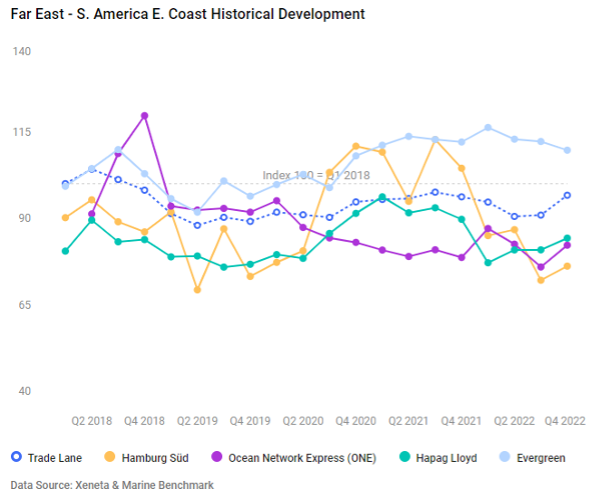
Xeneta has developed a new index to describe the CO2 emissions by major container shipping companies on specific trade lanes. The index names Hamburg Sud as a hero and Evergreen as a villain currently.
Unlike the IMO’s CII the index estimates CO emissions per unit of cargo, which may be a better measure for carriers to work on. It also lets Xeneta make a statement on how the line got their result.
For instance, Hamburg Sud got their good result mainly by slow steaming.
Here’s what Xeneta had to say about how the index is calculated:
“The CEI methodology, she explained, is based on data from Marine Benchmark and calculated based on AIS data, including speed, combined with modelled factors, such as weather data, loading.”
Source: article linked below.
We’ll want to follow this CEI index over time. Over time Xeneta gives us a graphical picture of several entities on the America East Coast trade. Here we see how various carriers and consortia are able to manage CO2 emissions via the CEI.
It’s no wonder that US intermodal traffic is declining. Poor service from the railroads has made using any system that involves a transfer an invitation to delays. And shippers can’t afford delays.
Companies offering intermodal container service don’t have enough pull with the railroads in the US to get highly regular service. And now that container rates are dropping fast, shippers won’t pay an excessive amount for the service. So the large rails don’t feel any obligation to serve them well.
Will the major rail lines make any adjustments? My guess is they will be dragged kicking and screaming to provide more reliable service. The fuss they are making over simply making regular deliveries of feed grains to major customers, and the resistance to reciprocal switching, and the labor difficulties they are experiencing show that they don’t feel that customer service is top of their mind.
Why not? Recently I read a book about Charles Lowell, a young man from Massachusetts who fought in the Civil War. Before the war, and after graduating first in his class from Harvard, he worked as an agent in Iowa for a firm building railways west in that state. Each time they completed 25 miles of railway, the firm got a large new swath of land from the US government. The firm had to survey the land, decide on their route through it, and sell the land they didn’t need to fund the next 25 miles. They sold the land to migrants, from the east or from other countries, who were moving west to obtain cheap land for farms and businesses, their piece of the American Dream. There was a lot of graft in these land dealings. But Lowell insisted that his firm sell at a fair price and not engage in special deals with investors speculating on the land. His reason was interesting and farsighted.
Lowell believed that the railroad needed customers, and that was what he was creating by selling them land.
Today’s railroad executives don’t seem to think they need customers.
There are plenty of reasons to use intermodal for container shipment. It reduces emissions. It could be faster. It could require fewer transloads. (Most US truck traffic from ports is transloaded to 53-foot truck chassis before a cross-country trip). And it could be safer, and cheaper, or at least no higher in price, for the shipper. Rail lines could participate in this effort to reduce pollution while making the business profitable for them by operating their lines efficiently to accommodate it. But it does require them to serve their customers, those who want to ship on intermodal.
Too bad rails can’t seem to focus on the advantages it offers and shape their business around it. It would save the hassle of government regulation forcing them to accommodate it.
Here we see another bet on ammonia power. One partner is the Swiss firm WinGD, which has a long history of providing power for merchant shipping. Their website gives no indication that they have a hydrogen or ammonia-powered engine yet. But they do offer dual-fuel engines that will utilize gas for fuel. Perhaps they are not so far away.
Another development partner, CMB.TECH, a clean technology private firm based in Antwerp, already has some design expertise for ammonia engines. A look at their site shows some hydrogen-powered vessels operating, and some ammonia-powered vessels on order. They also have some hydrogen-powered fixed engines and other machines such as an excavator that they say can be ordered today.
Handling of hydrogen or ammonia on board and at ports is a major concern with this technology. Watch for the designs to see how difficult this will be.




 Supply Chain and Logistics