Tag Archives: news

Resilience blind spot in shipment routing

Companies have done a lot of work on supply chains in the last year to improve their resilience to geopolitical glitches. It’s been hard work to diversify suppliers to different countries to lessen risk.

But another form of risk is control of the terminals and transfer points on shipping routes. The article here notes that the port of Shanghai in China has grown at over 6% annually, even though the Chinese economy only grew at 3.5%. What’s using all that capacity? The answer is that many shipping routes still move through Shanghai even though the origin and final destination of the cargo is not in China. The routes themselves are subject to disruption if relations with China sour.

It’s also worthwhile to point out that Chinese entities control or have major financial interests in many ports round the world. If a shipper really wants to assure some independence from China, she will have to examine their shipping routes as well as the country of origin.

Is there a way to look at this connectivity? The article suggests an analysis by SKU of the port connectivity involved in the supply. A high-level indicator is provided by UNCTAD’s port connectivity index, available at this link.

To see how the index works, read this: https://unctad.org/news/new-context-calls-changing-how-we-measure-maritime-connectivity The six major components are given here:

  1. Number of direct connections: The more countries can be reached through direct shipping services, i.e. without requiring a transshipment, the faster and less risky is the connection.
  2. Number of weekly calls: The more often ships depart from a port, the lower the waiting time for the shipper.
  3. Number of companies providing services: The more choices shippers have, the less likely they are confronted with potential negative impacts of oligopolistic or monopolistic markets (i.e. higher prices and lower service quality).
  4. A higher number of services is an indicator of shipping options for the importer and exporter. Services may be provided jointly by various carriers, and each carrier may provide several services.
  5. Total deployed carrying capacity: The TEU[i] that can be imported and exported to/ from a country is an indication of the total transport service supply.
  6. Size of the largest ship: Larger container ships are more likely to be deployed in hub ports, providing additional connectivity to importers and exporters from the port thanks to trade between third countries. Also, ports that can accommodate larger ships tend to have better port infrastructure and port services.

The connectivity index is only a rough tool at best for supply chain planners and logistics pros. One needs to investigate the individual routings used for SKUs, and that requires close cooperation and openness with carriers and any third-party firms you use for logistics management.

Furthermore the routing may change even though the carriers involved are the same. So it’s daily attention rather than autopilot. Perhaps this is a job for AI agents. Almost daily checks may need to be made.

Then, what do you do about it? Do you have the power to force a change? Do you want to pay for the change? These are not easy decisions, but they certainly require attention at operational, tactical and strategic levels.

I would not be surprised to see the emergence of startups that can provide dynamic routing visibility and costing, perhaps with AI agents. Such tools can help in the current world scenario. They are most relevant in the fast-changing world political scenario we are in today. That churn is creating costs for supply chains we couldn’t even imagine two years ago.

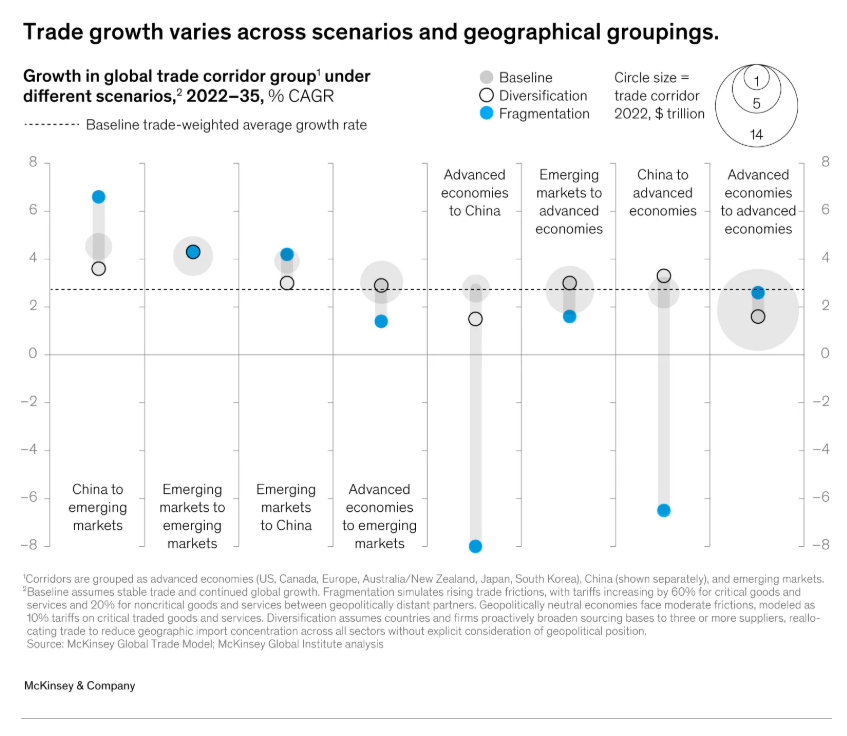
Some scenarios around the trade lanes are presented by McKinsey. The following graph shows some basic geographical groupings and three scenarios of activity, called Baseline, Diversification, and Fragmentation (the worst), over the period 2022-2035. Compound annual growth rates could range from +6% (China to emerging markets) to -8% (advanced economies to China). The source here is this web page. Such large adjustments over a long period means there’s a risk of stranding investments in infrastructure, including ports.

The people of the world will be much better served by open trade rather than fragmentation.

Splash December 15, 2025

https://splash247.com/shanghais-box-boom-exposes-a-resilience-blind-spot/

Loose cable connection destroys bridge?

The National Transportation Safety Board (NTSB) Office of Marine Safety released a report on the Dali bridge ‘allision’ (not a collision) that destroyed the Francis Scott Key Bridge in Baltimore MD USA.

We all read with amazement at the destruction of this major bridge, which carries much East Coast auto and truck traffic between New York-Philadelphia and Washington DC. The cost to repair it is estimated at well over a billion dollars.

What caused the accident? The ship owner, ship operator, captain, and many insurance providers will be anxious to find out who can be held financially responsible— who is to blame.

The report indicates there was prior knowledge before the voyage of a loose cable connection which could have been responsible for the ship’s major 440V power system blacking out. That could be a cause of the accident since it would include the steering system and engines.

The team performing the investigation had a wide variety of members including the shipbuilder, classification society, flag-state port authorities, shipowner, and ship managers.

It may take a year to get the final report out. So no decisions are possible for quite a while.

It seems like a potential for a loose cable is something that should have been taken care of immediately if discovered. The accident occurred on 26 March. Why was it not discovered and fixed in prior inspections? I believe fixing it would have been time-consuming, causing quite a bit of lost steaming time. Were prior inspections not rigorous enough to disclose such problems? Or were the possibilities simply ignored? Maybe the lawyers will find out! See the second article below. And the US government is getting into the act (third article).

With the bridge repair costs so high, the stakes are large.

Barry Parker, New York Freelance Correspondent

September 14, 2024

https://www.seatrade-maritime.com/accidents/did-a-loose-cable-connection-cause-dali-blackouts-

Sam Chambers September 18, 2024

https://splash247.com/dali-lawsuits-pile-up-in-the-us/

Barry Parker, New York Freelance Correspondent

September 18, 2024

https://www.seatrade-maritime.com/accidents/us-department-of-justice-files-100m-suit-against-dali-shipowner-manager

Dark fleets and Sanctions

We now have two worlds of international commerce, as a result of trade wars and the Ukraine-Russia conflict. As the Western world, principally the EU, UK and related countries and the US look to tighten sanctions on Russian oil exports, some shipowners are finding creative ways to get around the rules set by the West.

One important escape hatch is to flag ships with a Flag State that doesn’t enforce any of the sanctions. While this strategy may not get access to US or EU ports, it allows substandard ships, or those that don’t want to obey rules such as those banning ship-to-ship transfers without proper environmental and safety provisions, to trade with other countries.

Two stories caught my eye this week.

The first article notes that the Cook Islands nation has become a top 30 Flag State, due to the registry of ships that trade Russian, Iranian, or Venezuelan oil, all sanctioned by the Western Powers. Cook Islands is located in Polynesia, and is self-governing, but has an external defense relation with New Zealand. It consists of 15 islands, with a total area of 91 square miles. It has an Exclusive Economic Zone surrounding it, of some 770 thousand square miles. Many of its residents also have New Zealand citizenship. The population is about 15000 as of the 2021 Census. (All figures from Wikipedia, retrieved on July 29, 2024.)

Sam Chambers July 29, 2024

Dark fleet additions see Cook Islands become a top 30 flag

Apparently tankers are the primary ships flagged there; the Russian oil trade needs ships that will carry Russian oil sold at prices exceeding the $60 per barrel cap set by the Western sanctions. Often these are substandard tankers, and since they cannot land at Western ports they may not meet safety, environmental, or ship management standards. A Flag State like Cook Islands will not be in a position to enforce any of the international standards for safe operation.

The article also points out that LNG is also starting to be traded via a shadow gas carrier fleet, largely based in Dubai. Those ships will likely also be registered in Flag States that are unable to enforce international standards.

The second article shows why the shadow fleet is arising. India’s imports of Russian crude oil are skyrocketing to 1.8 million barrels per day compared to just 88,000 bpd in 2022. Part of the reason is logistical constraints, another important part is price. India can buy sanctioned oil at the reduced sanction price from Russia. But they can also buy other Russian oil, possibly at even lower prices, using the shadow trade.

Russian ports are not located where they can conveniently trade with India. But in the dark market, oil can be swapped and traded without incurring sanction restrictions, and more favorable transport obtained. Some movement did occur from the Black Sea through the Suez Canal, but that is now limited because of the Houthi attacks on shipping in the Red Sea. Ships now need to move around the Cape of Good Hope to reach India, adding many miles and days to the voyage. It’s more profitable for a dark fleet tanker, but adds to the full cost of the oil delivered in India.

The article talks about the dangers of using the dark fleet for moving oil. We can expect more oil spills and accidents due to the substandard condition of the ships and the failure of masters to follow international rules.

Seatrade logo

Paul Bartlett | Jul 29, 2024

Indian oil importers’ thirst for Russian crude drives dark fleet demand