Category Archives: Maritime Law & Policy

Panama Flag tonnage slips

Geopolitics is playing a role in selection of flag states. That includes both US pressure for supply chain control by nations in the Americas against China, and reactions by China. But Panama also wants to cultivate a pristine image as a flag state that supports and enforces international rules.

According to the most recent Clarkson’s Research data, Marshall Islands now ranks ahead of Panama in fleet tonnage registered. Liberia remains first.

Panama’s drop has two causes.

First, Panama has been actively removing shadow fleet and older tonnage from their registry. These are usually ships that run a risk of maintenance problems. Panama now limits tankers and bulkers older than 15 years. This is a sign that Panama wants to be known as a trusted registry, safety-conscious and willing to enforce maritime safety and management rules.

Panama stands out for the age of its fleet. Its average ship is 19.5 years old, the oldest among the top five flags. Liberia averages 12.6 years, the Marshall Islands 12, Singapore 11.3 and Hong Kong 14.9.

Second, Panama and China are crossing swords over the Panama government’s seizure of the CK Hutchison port terminals at each end of the Panama Canal.

This comes after the Hong Kong-based terminal operator, went through a phase of trying to sell the terminals. The original consortium was led by US investment firm BlackRock. However, no agreement could be reached, and the government of China said they would prevent the acquisition.

This seems to be reasonable evidence that China was indeed counting on geopolitical leverage from governance of the two ports.

Accordingly, Panama’s government went to its courts, and Panama’s highest court found that the port management contracts were illegal, and CK Hutchison would be displaced as the terminal operator. Panama is currently bidding the port management contracts and has placed temporary operators in control at the two ports.

Some think that the Panama government was encouraged or asked by the US to get rid of the Chinese influence at its ports, and the seizure by the high court was the result.

Fallout from this seizure has been action by China against Panama-flagged ships at Chinese ports. Chinese leasing companies have subsequently required some owners to reflag away from Panama when arranging newbuilding finance. Heightened Chinese scrutiny of Panama-flagged ships followed Panama’s removal of CK Hutchison-linked operators.

Some shipowners are switching to another flag to be able to access Chinese ports. This could certainly cause a decline in registered tonnage.

Graphs below, courtesy of Splash 24/7, show sizes of the top 10 and top 5 flag states.
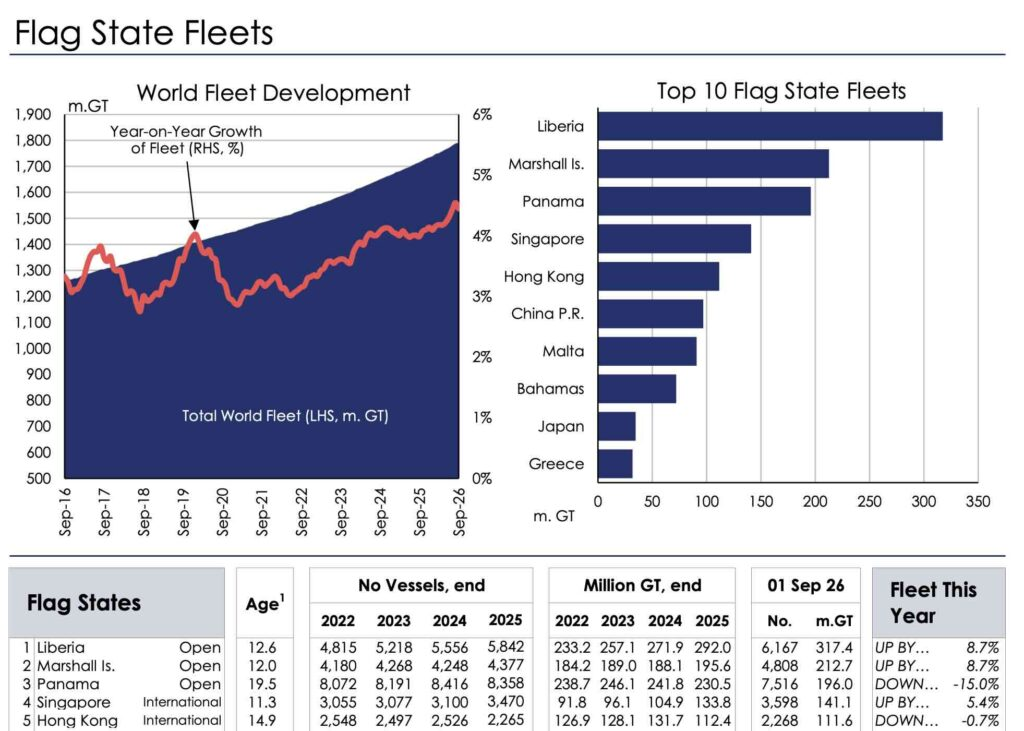
A graph illustrating the development of the world fleet, highlighting year-on-year growth percentages, alongside a bar chart showcasing the top 10 flag state fleets by size in million gross tons (m. GT) for September 2026.

Source: Clarksons Research, via Splash 24/7

Logo of Splash247.com featuring the word 'Splash' in bold black font with a blue underline, followed by '.com'.

Sam Chambers September 25, 2026

https://splash247.com/panama-slips-to-third-in-global-flag-rankings/

Insurance and Maritime Warfare

This interesting article points out how the nature and availability of insurance can be weaponized in wars such as Trump’s Iran action. If you have not been interested in maritime insurance before, you need to learn how it can work in such a dire situation as the Strait of Hormuz activities now.

It’s a war zone, to be sure. But many ships, shippers, and in fact countries, are dependent on passage. And they need insurance to do it.

Manipulating the insurance ecosystem is a potential way to shape the movement of ships in the Gulf of Hormuz or the Red Sea. It’s been used before, but we are now seeing novel approaches from the US government and from insurers.

Maritime shippers and operators will need to pay attention to this changing landscape.

By Bruce Randolph Tizes

https://mymaritimeblog.wordpress.com/wp-admin/post-new.php

Addressing Flag State Abuse in Shipping

There’s a lot more attention being paid to Flag States for shipping, and what kind of job they’re doing to police their members. Much of the attention is due to the abuse of flag state status by companies and owners who want to avoid being caught up in sanctions.

Sanction regimes from major powers, US, UK, EU Paris MOU, and Tokyo MOU, are getting more strict, and exposing companies to much more risk. However, if flag states don’t proactively enforce rules, they could attract ships that do not intend to play by the general international rules.

Some of these rules deal with insurance and protection for cargo owners. Some deal with care of mariners, and some with proper behavior in cargo handling, such as ship-to-ship transfers and carbon emissions in protected international spaces.

Here we highlight an example of lax enforcement turning into stricter rules. In this article, Cameroon, an African nation which operates a ship registry that has grown very fast recently, is going to purge the registry of ships that are sanctioned by the three sanctioning groups. Cameroon has also reportedly stopped new registration of ships known to be sanctioned.

Owners of those ships will need to move them to another registry. There have been frequent accidents involving ships with Cameroon registry; the average age of the fleet registered there is 32.7 years. This is much older than many operators choose to run ships.

Sam Chambers February 13, 2026

https://splash247.com/cameroon-clamps-down-on-shadow-fleet-as-flag-purge-begins/

Shipping rules are principally controlled by the International Maritime Organization (IMO) though other UN agencies play a role. In the next article, the IMO announced a campaign to combat fraud in ship registration. Fraud is a tactic often used by shadow fleet members to get around rules. These ships will claim to be registered in a flag registry when they are not. Sometimes the claimed nation does not even have a registry.

Flagging a ship in a nation’s registry makes shipboard conduct subject to that nation’s laws. Even when a ship is properly registered with a flag, there could be gaps between IMO standards, agreed to by most nations, and national laws. One prominent area is labor rules for mariners, which sometimes are violated by ships’ management.

The IMO can conduct audits of registries’ practice, and the consistency of national and international laws. It’s planning to step up those audits. This will make it harder for shadow shipping to continue practices that do not meet international shipping standards.

Published Feb 12, 2026 11:06 PM by The Maritime Executive

https://maritime-executive.com/article/imo-ramps-up-campaign-to-close-flag-state-enforcement-gap

Update 2/17/2026:

Madagascar, which has no registry, reports multiple ships falsely claiming it as a flag state.

Sam Chambers, February 17, 2026

https://splash247.com/madagascar-exposes-fraudulent-flag-scam/