Tag Archives: IMO

Green Corridors Hit ‘Realization’ Stage: The Zero-Emission Hurdle

The Getting to Zero Coalition and the Global Maritime Forum have issued a new report At a Crossroads: Annual Progress Report on Green Shipping Corridors 2025. Green shipping corridors are a very impactful way of moving toward zero emissions in the maritime area. They can coordinate many players by providing a specific attainable goal— zero emissions on a specific route for specific ship types. These corridors are independent of efforts by the EU to create incentives and penalties for carbon emissions and reductions, and of efforts by the International Maritime Organization (IMO) to reach a consensus on rules and measures for intrnational ocean shipping. Many times they are organized by specific ports and specific ocean carriers. Often they try to focus efforts on supply chains for specific fuels at those ports.

I think these efforts are extremely important. They can show how to provide reasonably priced fuel supply chains and how to coordinate investors, ocean shipping players, and financial institutions as well as governments. These experiments need to be tried.

The report has been published since 2022, effectively the beginning of the green shipping corridors movement. Steady gains have been made, and today there are 84 initiatives catalogued, with 305 stakeholders. 25 more initiatives have been recorded.

Source: Annual Progress Report on Green Shipping Corridors, 2025.

An interesting section discussed progress at the four corridors that have reached the highest stage in the journey: the Realization stage. Three of them are short-sea routes in Europe. The longest runs bulkers from Australia to China and other Far East ports.

  • Stockholm-Turku ferry, Finland to Sweden, biomethane;
  • Vaasa-Umeå ferry, Finland to Sweden, biomethane;
  • Australia-East Asia bulk carriers, iron ore, ammonia;
  • Oslo-Rotterdam container ships, hydrogen.

I found it interesting that the three short routes fund the difference between green and dirty fuels by entering pooling agreements to sell credits to other shipping lines, under the EU policies. The long ammonia route alone is driven by private firms involved in the trade, to help them meet dramatically lower emissions goals, with fuel costs not funded but expected to drop to a reasonable level as the infrastructure is built out. China, Korea, and Japan all have goals for reduced emissions from shipping which the iron ore route will help with.

Four recommendations emerge from the report’s assessment of the green corridor potential and progress.

  • Pursuing strategies to break the inertia and keep the momentum;
  • Connecting cargo owner willingness to pay to the corridors;
  • Taking an active stance at the IMO;
  • Tapping into or replicating emerging national policy instruments.

Significant issues for now are:

  • Delay of the IMO Net-Zero framework; participants may wait for more clarity.
  • Will the cargo owner be willing to pay for green shipping on the corridor? The evidence so far is not good.
  • Influencing public policies to support investment and regulation.
  • Staying focused on truly green corridors that deploy zero-emission assets rather than fossil fuels, do it early, and iron out the kinks.

This chart shows the right and wrong approaches:
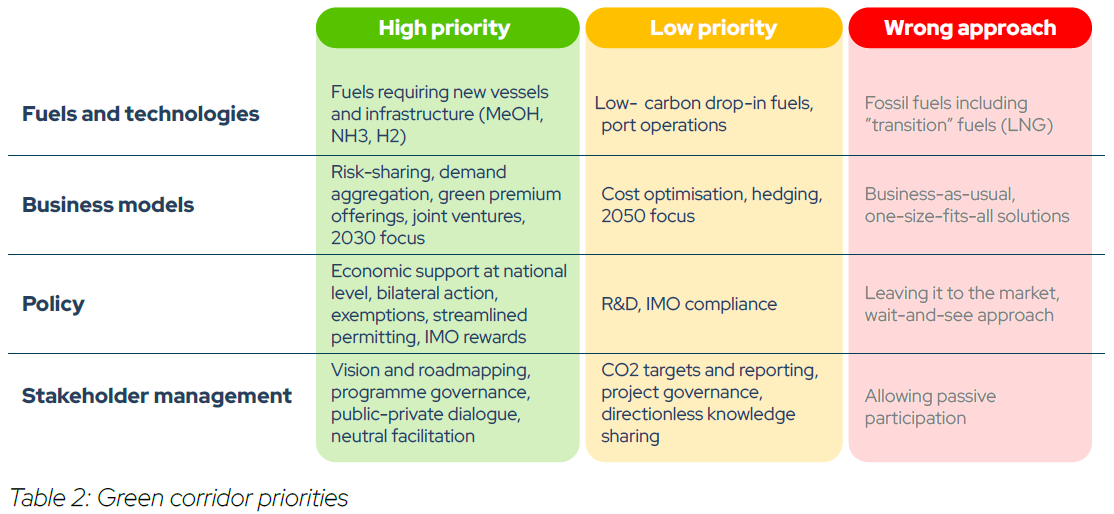
Source: Annual Progress Report on Green Shipping Corridors, 2025, page 25

The study is available in PDF at this link. It contains an Appendix listing all the current Green Corridors in the portfolio at present.

I was very happy to read this summary of the state of green corridor adoption. Keeping this movement going will play an important part in maritime decarbonization.

Gary Howard, Middle East correspondent November 27, 2025

https://www.seatrade-maritime.com/green-shipping/first-four-green-corridors-hit-realisation-stage

Ship It Zero’s green shipping shaming

Ship It Zero is a collective of US environmental groups. It has designed a new scorecard, with separate metrics for shippers and ocean carriers, for decarbonization efforts.

Many shippers, such as Costco, scored very low. And shipping lines were also graded low. The exception was Scandinavian lines and shippers. Maersk was graded B; most would agree that Maersk has been trying very hard to make moves for decarbonization, and is probably the leading liner company in that regard. Ikea also got a good grade, still only a B+ at 89/100.

Naturally both shippers and carriers were outraged, and had all sorts of criticisms of the scorecard. Most of those mentioned in the second article were the usual protestations, which no longer carry much weight. It’s abundantly clear that most carriers and shippers are making only minimal changes in practice to decarbonize.

One of the silliest criticisms is to blame it on the IMO (International Maritime Organization), a UN consortium of countries making rules for shipping. With over 130 members, it’s a surprise they can agree on anything. To say we would do more if the rules were stricter is really nonsense. Companies could do something now.

Ship It Zero points out that few shippers are even quantifying Scope 3 emissions. These are downstream emissions created by the firm’s customers. You can read an extensive and defining discussion in the Supplement to the Greenhouse Gas (GHG) Protocol Corporate Accounting and Reporting Standard.

How could an ocean carrier account for the emissions created by its customers? According to the standard, it could look at how the containers or bulk cargoes were being handled and transported ashore once landed. Are the drayage firms using EVs? What is the power source of the trains? How about storage and pipeline operation, is there leakage, or is excessive carbon or greenhouse gas emission occurring from pumping mechanisms? The same would apply to delivery to the ship.

For instance, Scope 3 emissions would include the GHG emissions treated by the firms producing and selling the fuel for ships. Green fuel sources would get higher scores than conventionally produced bunker fuel. Similarly if LNG were used as fuel, Scope 3 methane emissions from the bunkering sites should be considered, as well as the Scope 1 emissions onboard from burning the fuel.

Retailers can evaluate the Scope 3 GHG emissions created by their suppliers. They can also estimate the Scope 3 carbon emissions from use of the products they sell. Ikea for instance has invested in reducing the weight and materials used in packaging products to lower the carbon impact. Other firms could do the analysis with their products.

So I’m with Ship It Zero when it comes to the score. We can easily debate whether the score is considering all the factors. But there is no question that both shippers and carriers can and should do more, and stop simply greenwashing emissions.

Seatrade logo

Nick Savvides | Aug 07, 2023

Shippers and carriers unite against Ship It Zero’s green shipping shaming

Seatrade logo

Nick Savvides | Aug 03, 2023

Container lines outshine shippers in environmental standings

MSC: CII to soak up 7-10% of container fleet

The new measurements of carbon intensity for ships have gone into effect. The International Maritime Organization (IMO) created new regulations that went into effect on November 1, 2022. One of the measures is the Carbon Intensity Indicator (CII), intended for existing ships. It’s calculated as CO2 emitted per unit of ship cargo carrying capacity and nautical miles sailed, says DNV, classification society for maritime and an assurance and risk management expert (What is the CII?)

There are two different measures used in the calculation. One is the Annual Efficiency Ratio (AER), the annual emissions per ton mile, for segments where cargo is weight critical. The other is cgDist, emissions per gross ton-miles, for volume-critical cargo.

One of the criticisms of the measure is that it uses distance sailed rather than anything related to the amount of cargo. Actually, as of today, a similar rating using actual cargo carried, the EEOI, can only be reported on a voluntary basis, and may not be substituted for the CII. This has provoked some stern criticism from the large carriers that are heavily loaded, such as Maersk and MSC, though they will comply with the reporting regulation.

But these carriers and others have called for an early reform to the measure, to prevent a ship logging empty miles in order to improve its CII. Emissions are lower when running empty, since you’re not moving the weight of the cargo. So a tanker, for instance, can improve its CII ratio by deadheading back to its pickup point, rather than moving another cargo.

But these concerns are nits compared to the concept of rating all ships by their carbon emissions. These measures begin the process of making actual emissions available to the public, so shippers can make a choice to lower emissions.

One of the ways to reduce emissions is to sail more slowly, or slow steam. Gary Howard’s article quotes MSC, the large container line, that the new CII will cause a 7% to 10% loss of capacity due to slower steaming.

It’s an interesting number. It forces shippers to accept longer voyages before getting cargoes, a clear tradeoff between emissions and prompter delivery. For many customers this will not be an issue; they can alter resupply schedules if the reliability of getting it at the predicted time is high. However, reliability of shipments is another serious problem for container carriers— it’s down around 40% for most carriers. Most of the delay of recent shipments is due to blanked sailings, and to congestion loading and unloading in some major ports. Blanked sailings don’t affect the CII for ships. But congestion delays at ports cause fuel to be burned and push the CII up even if the ships don’t move many miles. the fuel is still used.

I think introducing the CII is a very good idea. True, it could be improved; but we have to start somewhere.

Seatrade logo

Gary Howard | Nov 01, 2022

MSC: CII to soak up 7-10% of container fleet