Tag Archives: supply chains

Quote

Flexport – moving beyond freight forwarding?

This article looking at Flexport now appeared recently under Cathy Morrow Roberson’s byline in The Loadstar.  We enjoy hearing about what Flexport is doing now.  But the idea that they are changing direction to become more like a 4PL is not the point. That’s where they were always going!!  The press and financial folks may have perceived them as a technology play.  But all along Ryan Petersen has intended to create a firm that actually helps customers manage their supply chains, by giving them visibility, a certain amount of in-depth analysis, and good service assistance in dealing among supply chain partners, temporary or permanent.  I don’t think the vision has changed; just the world’s view of it.

  via The Morrow-Roberson road test: Flexport – moving beyond freight forwarding  – The Loadstar

Quote

Swine fever set to reduce China’s soybean imports further: USDA

Asim Anand writes in Platts agriculture report that China is suffering from substantial losses in their pig population due to African swine fever (ASF).  The pig herd has declined by 20%, and that translates to less need for soybeans.   Estimates run to 22 million mt less.

I’ve been watching the world soybean flows since 2014 when my colleague Cris Clott and I, working with Althea and Libby Ogard, and with help from Scott Sigman, wrote an article about the soybean flows and the possibilities for containerization of soybeans as opposed to bulk transport.

US soybean exports to China have fallen by 85% due to the imposition of a tariff of 25% on US products by China.   So world wide there is a glut of soybeans and prices are dropping fast. Prices of US soybeans are under $9 per bushel, the lowest since 2016. (See graph from USDA-NASS).
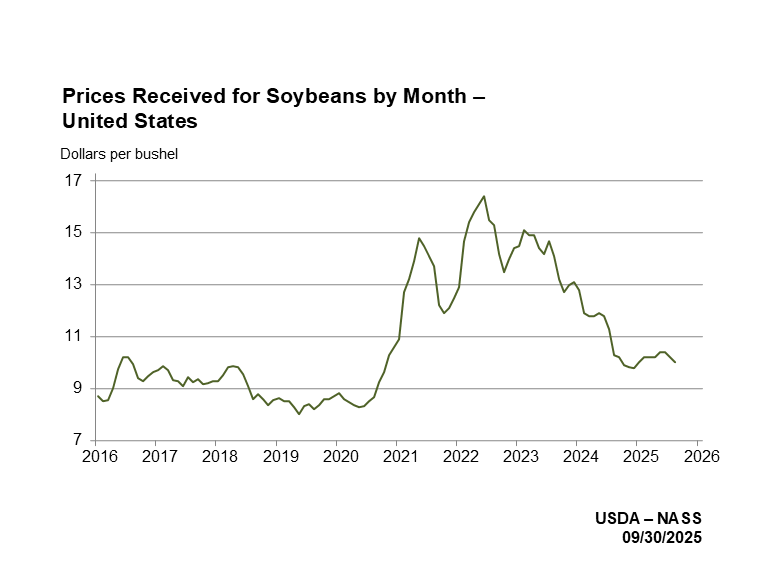
Prices Received: Soybean Prices Received by Month, US

Graph from https://www.nass.usda.gov/Charts_and_Maps/Agricultural_Prices/pricesb.php retrieved 2019-05-14.

We can expect this trend to continue, and as the trade war with China escalates, US soybeans will cease to be exported to China at all.  Exports represent about half of the US production each year, and China is the largest customer.  We can hope for a change, but I’m guessing this market is virtually gone for the US, as the other soybean-producing countries, Brazil and Argentina especially,  move in and establish supply chains around the world.

 

screenshot SandP Global Platts  via Swine fever set to reduce China’s soybean imports further: USDA | S&P Global Platts

Quote

Drought forces Panama Canal draught restrictions and pushes up rates

 has a good interview in The Loadstar with Jon Slangerup of AGL (American Global Logistics, a forwarder), who is the former head of the Port of Long Beach.  the recent drought has forced the Panama Canal to raise rates, and spot rates to the US East Coast have increased 14% or more.  This may put a dent in the so-called East Coast routing of containers from the Far East.

But Mr. Slangerup made another comment very interesting to a long time observer of the debate about whether the improvements to the Panama Canal would actually win traffic from the West Coast ports such as Long Beach, Los Angeles, and Oakland (let alone Seattle).

He noted that one could view the recent increases of Panama canal traffic as simply a recovery to normal after a long time in which the canal was operating in a reduced fashion because of the construction.  (The canal opened the expansion on 26 June 2016.)  He doesn’t think that the improvements have significantly altered proportions of traffic in the long run.

He also pointed out that many if not most freight buyers are concerned primarily about price.  Unless the Panama Canal can couple reduced tariffs with expanded capacity, shippers may not choose those routes in preference to the West Coast passage, which is also improving even for transit to Europe.  There has been a lot of progress in eliminating delays on the West Coast routes as well.  Slangerup noted that dock-to-rail loadings at the West Coast ports has increased from 23% to 30% and is being driven upward toward a goal of 50%. And there have been gains at the Chicago transfer points due to implementations by several railroads of PSR (precision scheduled railroading). For example, see this article by Julie Shneider in Progressive Railroading.

logo2  via Drought forces Panama Canal draught restrictions and pushes up rates – The Loadstar