Geopolitics is playing a role in selection of flag states. That includes both US pressure for supply chain control by nations in the Americas against China, and reactions by China. But Panama also wants to cultivate a pristine image as a flag state that supports and enforces international rules.
According to the most recent Clarkson’s Research data, Marshall Islands now ranks ahead of Panama in fleet tonnage registered. Liberia remains first.
Panama’s drop has two causes.
First, Panama has been actively removing shadow fleet and older tonnage from their registry. These are usually ships that run a risk of maintenance problems. Panama now limits tankers and bulkers older than 15 years. This is a sign that Panama wants to be known as a trusted registry, safety-conscious and willing to enforce maritime safety and management rules.
Panama stands out for the age of its fleet. Its average ship is 19.5 years old, the oldest among the top five flags. Liberia averages 12.6 years, the Marshall Islands 12, Singapore 11.3 and Hong Kong 14.9.
Second, Panama and China are crossing swords over the Panama government’s seizure of the CK Hutchison port terminals at each end of the Panama Canal.
This comes after the Hong Kong-based terminal operator, went through a phase of trying to sell the terminals. The original consortium was led by US investment firm BlackRock. However, no agreement could be reached, and the government of China said they would prevent the acquisition.
This seems to be reasonable evidence that China was indeed counting on geopolitical leverage from governance of the two ports.
Accordingly, Panama’s government went to its courts, and Panama’s highest court found that the port management contracts were illegal, and CK Hutchison would be displaced as the terminal operator. Panama is currently bidding the port management contracts and has placed temporary operators in control at the two ports.
Some think that the Panama government was encouraged or asked by the US to get rid of the Chinese influence at its ports, and the seizure by the high court was the result.
Fallout from this seizure has been action by China against Panama-flagged ships at Chinese ports. Chinese leasing companies have subsequently required some owners to reflag away from Panama when arranging newbuilding finance. Heightened Chinese scrutiny of Panama-flagged ships followed Panama’s removal of CK Hutchison-linked operators.
Some shipowners are switching to another flag to be able to access Chinese ports. This could certainly cause a decline in registered tonnage.
Graphs below, courtesy of Splash 24/7, show sizes of the top 10 and top 5 flag states.
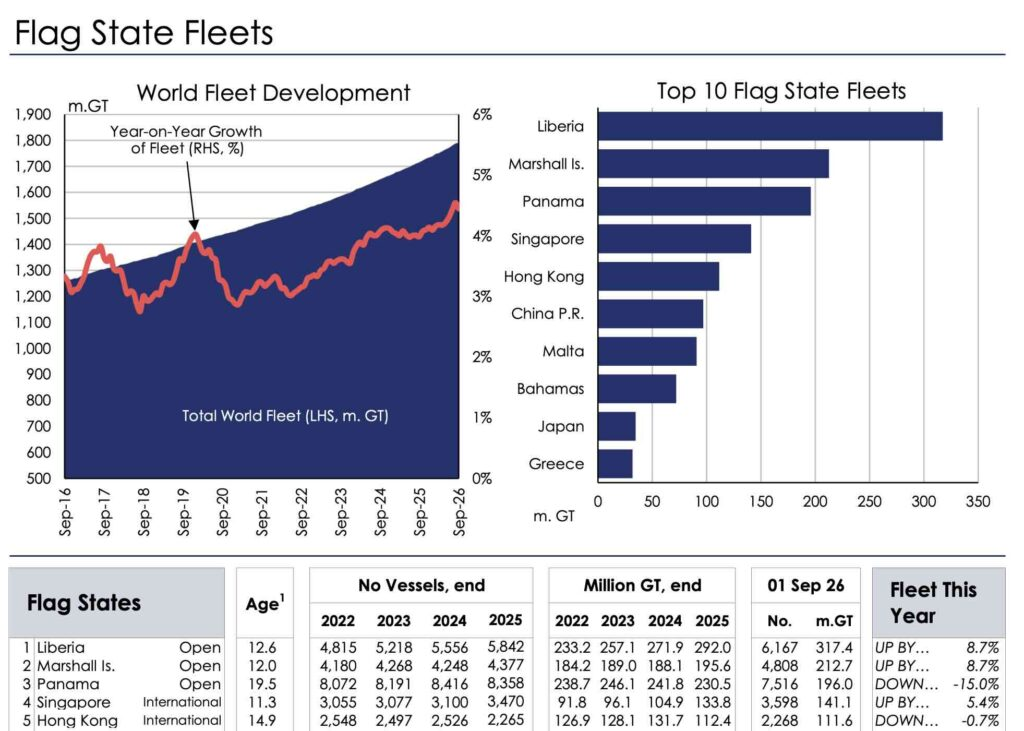
Source: Clarksons Research, via Splash 24/7

Sam Chambers September 25, 2026
https://splash247.com/panama-slips-to-third-in-global-flag-rankings/