Tag Archives: supply chains

Is a New West Coast Container Port Needed? The Coos Bay Dilemma

Coos Bay, OR, USA is pushing for a new West Coast US container port. It will have rail to the port, so that transloading can take place directly to it.

The port planners see a need for another West Coast port of entry for Asian containers that will reach inland via intermodal rail as far as Chicago. The Oregon International Port of Coos Bay has obtained a $25 million grant for pre-planning and pre-construction. The grant will be matched by $25 million from NorthPoint Development, and will be used for environmental review and preliminary engineering activities.

The map below shows why environmental concerns might be considerable. Coos Bay is a small town that’s long been a Mecca for beachgoers and people who love the coastside style of living. A friend moved there from Santa Rosa, in the Bay Area, for that reason.
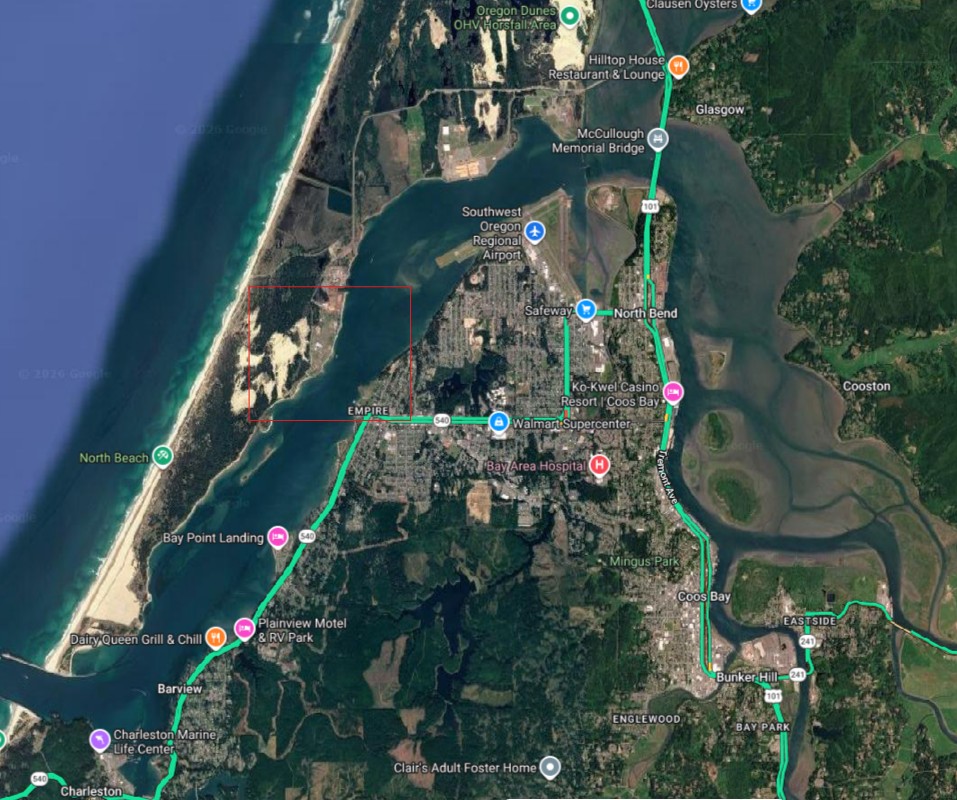
Google Map of Coos Bay, OR. Red square shows the approximate location of the new container port.

You can see on the map that ingress is through a small strait, with a narrow bay running northward to the Coos River. The port will be on the barrier island, just below another industrial site, a sawmill, according to the planning material. Its projected capacity will be 2 million TEU, or one million forty-foot containers per year.

That’s quite a few. It’ s only a bit smaller than the Port of Oakland, in CA, which runs about 2.5 million TEU per year. And it dwarfs the container traffic at the Port of Portland. However, Portland specializes more in automobiles, and grain and minerals bulk. If the port runs at 60% capacity, a reasonable figure for international container ports, that would be 1.2 million TEU per year, or 500,000 forty-foot units.

It’s not a bad idea, geopolitically, to have another West Coast port for containers. It’s a relief valve for the big California ports, which are subject to periodic longshore union strikes and other potential disruptions. Those ports are also major sources of pollution.

The all-rail connection should also make air pollution less of a problem. Perhaps the port can prevent local drayage from causing mammoth traffic and air problems in this pristine area.

Notice Charleston Marine Life Center at the entrance to the strait, a branch of the University of Oregon. Below is a photo of a Dungeness Crab, a local resident; delicious and protected from overfishing. Dredging, which the plan says is necessary, may threaten marine species nearby.

Boxes will move via a short line, Coos Bay Rail Line, owned by the port. It runs north from the peninsula about 137 mi, terminating near Eugene OR at the Union Pacific line. That provides access by rail to all of the central US. And if the UP/NS merger comes to pass, it will provide a single transfer access even to the Northeast US and even Europe. That provides access by rail to all of the central US. And if the UP/NS merger comes to pass, it will provide a single transfer access even to the Northeast US and even Europe.

It’s not clear that more capacity is needed on the West Coast of the US, particularly if interntional maritime trade is resetting and the Asia-US container movements are declining.

Evidently East Coast container traffic is also in decline.

We see a report today of Charleston, on the US East coast, shutting down a 700,000 TEU capacity terminal, Leatherman, because of low demand. It only processed 75,455 containers so far this year. The final capacity of Leathrman Terminal when built out is planned to be 2.4 million TEU. A second berth construction project is being continued. The planned rail yard adjacent to Leatherman, a $690 million project, is being suspended.

freigntwaves logo

Trains.com Staff Wednesday, June 24, 2026

https://www.freightwaves.com/news/oregon-port-oks-federal-rail-grant-agreement-for-multimodal-project

Jun 25, 2026 4:59 PM by The Maritime Executive
https://maritime-executive.com/article/charleston-pauses-operations-at-new-terminal-citing-low-volume-high-costs

California’s BIG Project: Transforming Rail Logistics

Here’s a project that should have happened 20 years ago.

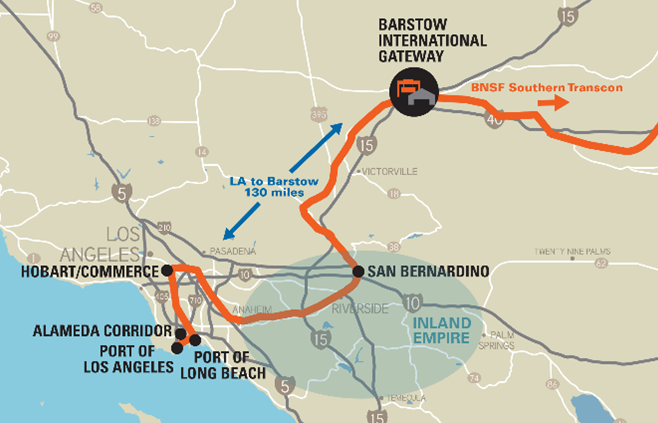
California’s major ports, at Los Angeles and Long Beach, have been desperate for relief from drayage traffic for containers they bring in. It was a struggle to get rail to the ports so that containers could be directly loaded. In 2002 the Alameda Corridor began to move double-stack double-track trains from near (but not on) the ports to the San Bernardino area. But rail service to the bulk of the US was still elusive. Transloading to 53-foot truck containers was the main activity in the Eastern valley. And that led to more truck traffic on the already busy freeways.

Remember that in the earlier days, pre-COVID, the land-bridge was still a preferred route from Asia to Europe. Ship to LA/Long Beach, Rail to New York or another eastern port, and ship again to Europe. It was lower cost and shorter time than any other Asia-North Europe route. And that included the numerous delays in moving goods by rail out of the port areas.

The problem has been urgent because of air pollution from the many drayage trucks traversing the area. California has been trying to address this problem from many directions. One of the first methods was the Clean Trucks program, which banned engines earlier than 2007 carrying to and from ports, and imposed other requirements on NOx and particulate emissions, especially PM2.5, a demonstrated pathogen for breathing problems. Gate reservations came next, as an attempt to articulate delivery and pickup with container movements in the yard.

But many noticed that switching from truck to rail would cut pollution even faster, and perhaps even improve efficiency. Numerous researchers, including my coauthor Chris Clott and me, suggested that moving functions off the port quickly to inland sites, called inland ports, would work. We even suggested, back when the land-bridge was functioning well, that inland ports as far away as Chicago could boost efficiency. The ports were not interested at that time.

Meantime, the ports and private firms have invested in the Alameda Corridor, which took double-stack, double-track trains through a frantically busy melange of LA suburbs, with many overpasses and intersections that had to be rebuilt, and many regulatory challenges.

Now finally, BNSF, a major Class I railroad, one of two serving the West Coast, has committed to a large inland rail intermodal terminal. It’s near Barstow, CA, out in the desert, kind of toward Las Vegas. This large inland port will be able to eliminate over 200 million truck miles by its completion in 2028.

The latest yard technology will be used, including zero-emission cranes, forklifts, and hostlers, electric plug-ins for refrigerated containers, and hybrid rubber-tired gantry cranes. BNSF has also committed to use the cleanest available switching locomotives in the yard.

The project is appropriately nicknamed BIG (for Barstow Intermodal Gateway). The press release says “By relocating container sorting and processing from congested port-adjacent communities to Barstow—a high desert hub with strong transportation infrastructure—the project enables a major mode shift from trucking to cleaner, more efficient rail.”

California and its residents are serious about industry controlling pollution.

Stuart Chirls·Wednesday, June 17, 2026

https://www.freightwaves.com/news/bnsf-wins-local-approval-for-new-4b-california-rail-intermodal-project

Christopher Clott, Bruce C. Hartman, Supply chain integration, landside operations and port accessibility in metropolitan Chicago, Journal of Transport Geography, Volume 51, 2016, Pages 130-139, ISSN 0966-6923,
https://doi.org/10.1016/j.jtrangeo.2015.12.005.

Cold-chain hubs crucial for produce imports

Cold-chain logistics are more complicated than ever. When many fresh products are imported, it’s crucial to have warehousing facilities that can handle many aspects of importing as well as storage and transshipment. Large brokers recognize this.

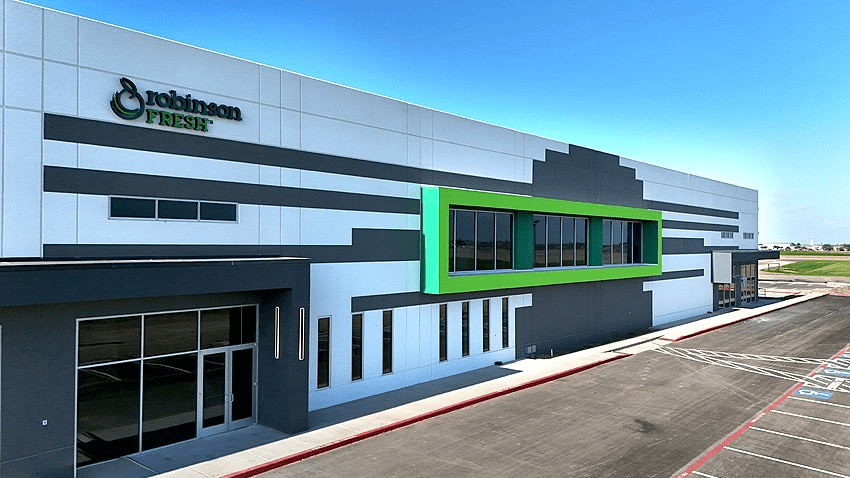
The article here shows that CH Robinson division Robinson Fresh is moving to benefit from the increasing tide of Mexican and South American produce coming into the US. The new facility in Pharr, TX is state-of-the-art, and helps Robinson provide a ‘seamless experience’ for their customers. It cost over $33 million.

Located in the town of Pharr in the Rio Grande Valley, the South Texas facility is one of the largest in the region. (Photo: Robinson Fresh)

Robinson Fresh is a division of brokerage giant C.H. Robinson focused on produce and perishable supply chains. The company services grocery retailers, wholesalers and foodservice customers across North America, including companies such as Whole Foods, H-E-B, Walmart and Sysco.

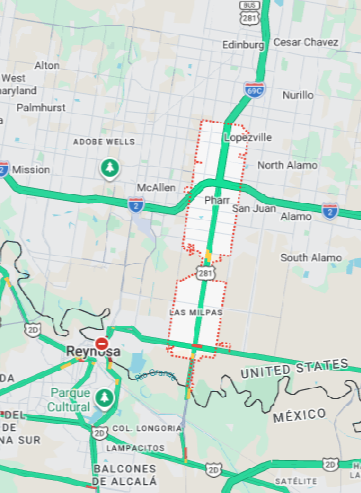
Pharr, TX is in Hidalgo County near McAllen in southeast TX.

The Rio Grande Guardian provides more background. Over $50 billion in trade now crosses the Pharr-Reynosa Bridge each year. It’s all handled by truck. “We’re crossing about 1.2 million trucks a year through this bridge,” Luis Bazan, director of the Pharr International Bridge, said recently at the August meeting of the South Texas Manufacturers Association.

On average, between 2,700 and 3,200 commercial trucks pass through the Pharr-Reynosa International Bridge heading northbound into the United States each day. Traffic volume depends heavily on the agricultural and manufacturing seasons. Peak Months: Up to 3,200 trucks per day (largely driven by the winter and spring produce harvest, as Pharr is the nation’s leading port of entry for items like avocados). Slower Months: Around 2,700 trucks per day.

Combining both northbound (into the U.S.) and southbound (into Mexico) commercial traffic, the bridge handles over 5,000 total trucks daily, amounting to roughly 1.2 million truck crossings annually.

There’s another bridge, Anzalduas, just west of Reynosa, and there are rail connections to the ports at Brownsville TX – Matamoros MX. These logistics nodes place the Pharr facility in a key location for facilitating international perishable and cold goods trade.

“These facilities specifically focus on imports that come from Mexico and South America,” Robinson Fresh President Jose Rossignoli said. “We’re talking about mangoes, bananas, avocados, tropicals and limes. It requires a certain ability of repacking, quality control and consolidation.”

With international trade becoming more complex, the role of full-service brokers seems sure to grow. CH Robinson has recently been on a mission to become a more proficient operator. The current President and Chief Executive Officer of C.H. Robinson is Dave Bozeman. He officially took on the role in June 2023. Prior to leading the logistics company, Bozeman held executive and operations roles at Ford, Amazon Transportation Services, Caterpillar, and Harley-Davidson. He was a legend at Amazon for his focus on measurable results, wise use of technology, and lean leadership.

Noi Mahoney·Friday, May 22, 2026

https://www.freightwaves.com/news/robinson-fresh-opens-border-cold-chain-hub-as-mexico-produce-imports-grow

Steve Taylor – Posted Sunday, September 1, 2024 12:23 pm

https://riograndeguardian.com/stories/bazan-pharr-reynosa-international-bridge-is-now-crossing-50-billion-worth-of-trade,15934