Tag Archives: supply chains

America’s copper paradox

Copper is an important mineral in this electric and electronic age. It’s not exactly in short supply, but it takes a long time to start up new supply sources in the US. Taseko Mines harvested its first copper cathodes at Florence Copper in early March 2026, ending an roughly 18-year drought of entirely new US copper mines built from scratch. (See second article below).

Several mines are under development in Arizona. I’m an interested observer of mining; I worked for a very fine mining company long ago, which operated a very large copper mine outside Tucson AZ USA. I learned a lot about copper and other mining operations, much of which is now out of date— the world moves on!

The interest in this story is the intricacy of metals supply chains. It’s been impossible to build a smelter in the US in recent years. Smelters produce many noxious materials, and no one wants them nearby. So copper mined in the US must either be processed on-site, using a process called solvent extraction-electrowinning (SX-EW) or be shipped elsewhere to be upgraded to commercially usable copper. Affinity highlighted a critical bottleneck: smelting. Only two primary copper smelters remain operational in the country, meaning new domestic mine production does not necessarily translate into domestically refined metal. It has to be shipped overseas to be processed.

Rio Tinto’s giant Resolution Copper project in Arizona could eventually supply more than a quarter of US copper demand, according to Affinity. This project is forging ahead despite intense criticism from Native American tribes and citizens who deplore the landscape devastation an open pit copper mine creates. US law does not require mining operators to remediate land they have destroyed while mining.

To process the deep underground ore, Resolution Copper will perform the initial extraction and concentration on-site, but they will not do the final chemical refining on-site. Instead, they will use a two-stage approach: processing the ore into a high-grade powder called “concentrate,” and then shipping that material to external commercial customers for smelting and refining.

So many current plans do not eliminate the need for foreign involvement in metallic copper production.

Broker Banchero Costa reported that the US imported a record 225,094 tonnes of refined copper and copper alloys in July, the highest monthly total in data going back to 1990. The figure was up 78% month-on-month and 8% year-on-year as traders rushed material into the country ahead of possible tariffs.

It’s really hard to eliminate dependency on foreign infrastructure in today’s world. and perhaps we should not want to, but rather cultivate alliances and friendships with countries that can help us. Copper smelter capacity is spread around the world. Data below is from World Population Review.
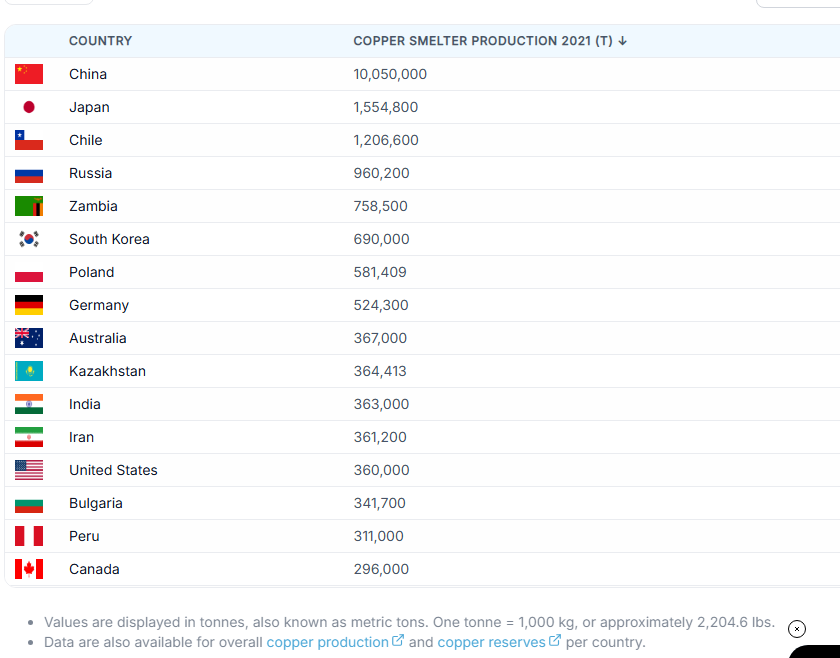
Table showing copper smelter production by country for 2021, listing countries and their production values in tonnes.

Japan and Korea and India would be good candidates. Except for Chile and Canada, these countries are far from the US. Both also produce large quantities of copper. That means a large need in the US for shipping capacity to and from the foreign smelters.

Logo of Splash247.com featuring the word 'Splash' in bold black letters and '247.com' in blue.

Sam Chambers September 17, 2026

https://splash247.com/americas-copper-paradox-sets-up-new-seaborne-trade-flows

Logo of Investing News Network with the tagline 'Your trusted source for investing success'.

Written by Dean Belder Apr. 23, 2025 01:55PM PST

https://investingnews.com/next-us-copper-mine

Logo of World Population Review featuring stylized figures and a globe

https://worldpopulationreview.com/country-rankings/copper-smelter-production-by-country
AI use growing, but cost…?

This report by McKinsey, the global consulting firm, sheds some light on what’s happening in the commercial realm with AI. It’s based on an online survey taken in May and June 2026, with 1,719 participants in 97 nations, spread across a full range of regions, industries, company sizes, and functional specialties. 36% of respondents work for companies with more than $1B USD in annual revenue.

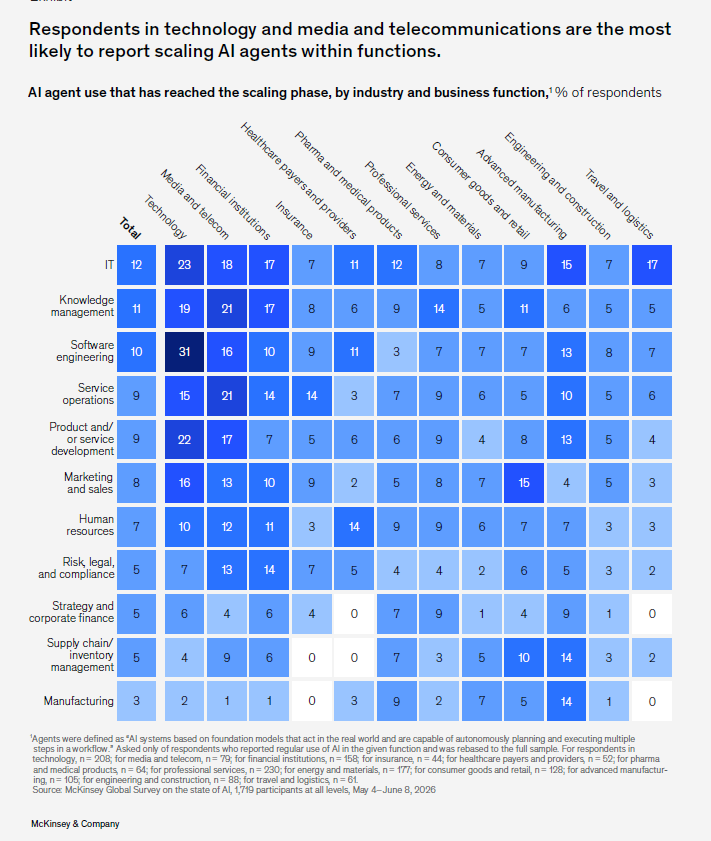
The heat map below, from the report, shows the relation of AI use that has passed beyond R&D into scaling phase by industry type and business function. The entries are the percent of respondents who say their firm is into the scaling phase. The business function rows are ranked by total percent.

What stands out?

  • How low are supply chain and manufacturing functions!! You would think there would be a lot of applications in these business functions. But, NO! Maybe it’s just because these functions are typically cost-conscious and slow to choose new technology.
  • But in advanced manufacturing, industry use in supply chains and manufacturing is close to the highest at 14%.
  • IT, knowledge management and software engineering are high. That’s what one expects when a technology such as AI emerges. We saw the same thing with the coming of the internet in the late 1990s.
  • Media is high!! What a surprise! The AI engines train on large quantities of media output. If they just operate as a grandiose search engine, they already add value of a kind we can appreciate.

One of the fascinating tidbits from the report is that chatbots are the most frequently employed form of AI. We guess that already, if we use the internet at all today. Every website seems to have one. And if my experience is any guide, they are mostly useless. They give answers to stupid questions, and can’t handle anything even slightly complicated. The most they do is have a real agent call you, and mostly they don’t do that. They direct you to someplace in the company’s sitemap, which you have probably already read without profit before desperately trying the chat.

I question whether this is the best use of all the energy and other resources consumed searching and re-searching all those tokenized training documents.

We haven’t yet seen the real cost of all these searches, over and over again, of all those training documents. It’s measured in tokens, and currently the tokens are underpriced as a loss leader to get us hooked on using AI instead of the far simpler internet search like Google. We see in daily news how many massive data centers are being built, how much resource they consume (electricity, water, grid capacity). Those costs have to be paid for in a viable business. They have no choice but to charge us for the use.

Just like internet and cell phones and cable TV, and phone service before that, we users will have to pay.

Dan Tinkoff, Lieven van der Veken, Michael Chu, and Tara Balakrishnan, August 2026

Low-water for Rhine and Danube

The drying-up of Central European rivers is radically affecting goods movement there.

The graph below shows water levels at two gauges, one on the Rhine and one on the Danube. Both are dramatically lower. Barges on these rivers can carry less than 30% of their capacity. This prevents containers that arrived at Rotterdam and Antwerp and Hamburg area, for instance, from making it upstream to their destinations. Those goods will have to travel by road.

That’s not a good thing. It adds to air pollution, uses more oil-based fuel, and stresses highway systems already near capacity.

Europe has bet big on river traffic as a cleaner alternative to road carriage. For a few years, it worked. Now it is threatened by climate change.

There’s no way to predict when, if ever, the rivers will come back.

19 Aug 2026

https://www.drewry.co.uk/maritime-research-opinion-browser/kaub-gauge-falls-to-an-historic-low